
Agentic commerce readiness for AI shoppers
Agentic commerce readiness guide: product data, carts, checkout, mandates, policy, and support for 8 AI-shopping failure modes.
Share
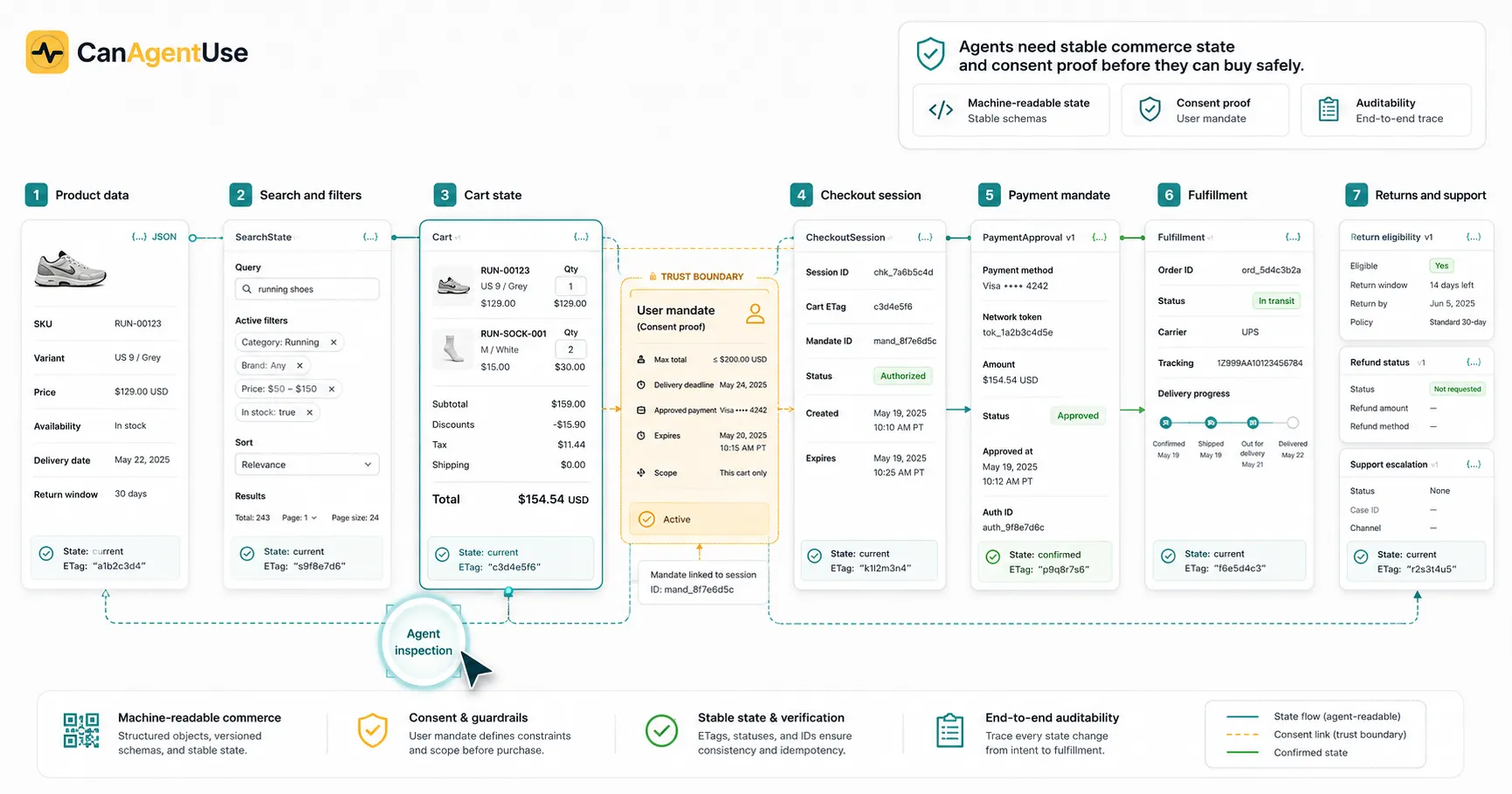
Agentic commerce is what happens when the buyer is no longer the only operator in the shopping journey. An AI agent can search, compare, filter, configure, add to cart, ask for approval, pay, track, return, and escalate support.
That does not mean the agent should be allowed to buy anything it wants. It means ecommerce systems need to expose enough facts, state, and guardrails for software to help without quietly making a mess.
Google's Universal Commerce Protocol describes a standardized layer for discovery, capabilities, checkout, payment handlers, order management, and integration through APIs, A2A, and MCP (Google Developers Blog, "Under the Hood: Universal Commerce Protocol", 2026-06-29). AP2 and related payment work move the trust problem toward mandates, proof of consent, and transaction accountability. Recent security research on agentic payment protocols goes further: static authorization is not enough when agents retry, orchestrate tasks, and run concurrently (Lan et al., "Zero-Trust Runtime Verification for Agentic Payment Protocols", 2026-06-29).
So the readiness question is not "Do we have a chatbot?" It is sharper:
Can an AI shopper understand the offer, preserve the user's intent, prove the cart state, request valid approval, complete the right transaction, and recover when something changes?
Most stores are not ready for that. Not because they lack a protocol. Because their commerce facts are scattered across product feeds, client-side components, cart UIs, payment widgets, policy prose, email receipts, and support portals.
TL;DR Agentic commerce readiness is the ability of an ecommerce system to support AI-assisted buying across discovery, product comparison, cart construction, checkout, payment authorization, fulfillment, returns, and support. A ready store exposes stable product identity, variant data, pricing, policies, cart state, user consent, idempotent checkout, and post-purchase state. UCP, AP2, MCP, and A2A can help carry those objects, but they do not fix unclear product data or brittle checkout flows by themselves.
Agentic commerce readiness means a store can be used safely by software acting for a user. AI shoppers are agents that operate under buyer constraints such as budget, delivery date, size, brand preference, return window, address, payment method, and approval rules. Commerce mandates are explicit permission records that bind an agent action to user intent, such as "buy this item if the total stays under $150 and delivery arrives by Friday."
The boring details matter. In our audits, an agentic commerce failure usually starts with something small: "navy" becomes "midnight," a cart total changes after shipping, a coupon error disappears, a product card hides size availability in an image, or checkout uses the same button label for review, payment, and confirmation. We tested these failures as state problems, not copy problems. A person can often notice and compensate. An agent needs evidence.
From our testing, the fragile part is rarely one endpoint. It is the handoff between product facts, cart state, policy, approval, payment, and support. In our experience, commerce teams find the hardest bugs only after they compare the product page, cart, receipt, and support portal side by side.
This article is a technical checklist, but not the lightweight kind. It treats agentic commerce as a system architecture problem: data model, browser UX, protocol surface, authorization, fraud, order state, and support.
Reviewed under the CanAgentUse editorial process; see our about and contact pages for context.
What changes when the shopper is software?
An ordinary ecommerce site is built around a human loop: look, infer, click, correct, read, decide. The site can rely on visual hints and patience. The shopper can remember that the selected color was on the previous screen. They can see that "free shipping" vanished after changing address. They can call support if a return policy is unclear.
An AI shopper works differently. It builds a state model from available evidence and acts from that model. If the page does not expose the selected filter, the agent may not know whether the filter applied. If the cart does not preserve variant identity, the agent may approve the wrong item. If the checkout button says "Continue" at every step, the agent may not know when it is crossing the payment boundary.
The shift is easiest to see by comparing the old journey with the agentic one:
| Commerce step | Human shopper expectation | AI shopper requirement |
|---|---|---|
| Product discovery | Browse and interpret cards | Queryable product identity, attributes, availability, and canonical URL |
| Comparison | Read pages and reviews | Consistent facts across feed, page, schema, and cart |
| Filtering | See selected chips and counts | Inspectable selected state, result count, sort, and empty states |
| Cart | Check a visual summary | Stable line items, variant IDs, totals, discounts, taxes, shipping |
| Approval | Click final purchase button | Explicit user mandate tied to cart facts and upper bounds |
| Payment | Use saved method | Tokenized payment handler, consent proof, fraud controls |
| Fulfillment | Read email or account page | Order ID, status vocabulary, carrier, ETA, exceptions |
| Returns | Interpret policy page | Return eligibility, window, fee, label method, refund timing |
The agent needs more than content. It needs commerce state.
That is the big difference between "AI SEO for ecommerce" and agentic commerce readiness. AI SEO asks whether a product can be discovered or cited. Agentic commerce asks whether an agent can carry a buyer's intent through a transaction without corrupting it.
Agentic commerce readiness is not a chatbot feature. It is a commerce-state problem across discovery, product data, cart state, checkout, payment authorization, fulfillment, returns, and support. Google's UCP specification treats these as commerce capabilities, while AP2-style payment work adds user-consent proof and transaction accountability.
What should product data look like when agents compare offers?
Product data has to become decision data. A product listing that is adequate for a grid page may still be too vague for an agent making a constrained purchase.
Consider a simple user request:
"Find me a black carry-on suitcase under $180 that fits most US airline cabin limits, can arrive by Thursday, and has free returns."
That request touches product identity, color, size, price, shipping promise, policy, availability, and confidence about airline fit. The agent cannot solve it from a hero image and a marketing paragraph.
A product page should expose these fields in text, schema, feed data, and cart confirmation:
| Data type | Agent-ready requirement | Common failure |
|---|---|---|
| Product identity | Stable product ID, canonical URL, brand, model, title | Same item has different names in feed, page, and cart |
| Variant identity | Explicit size, color, material, region, bundle, configuration | Variant shown only through image swatches |
| Availability | In stock, low stock, backorder, pickup, region limits | Product appears available until checkout |
| Price | Unit price, currency, sale conditions, subscription terms | Price changes without explanation after cart |
| Delivery | Shipping options, cutoffs, ETA, address dependency | "Arrives soon" with no date or method |
| Returns | Window, condition, label fee, exceptions, refund method | Policy hidden in long prose |
| Compatibility | Works-with list, dimensions, model numbers, constraints | Critical fit data buried in PDF or image |
| Risk labels | Final sale, age restriction, hazmat, warranty, regulated goods | Restrictions appear after payment attempt |
The consistency problem matters more than most teams expect. If the product page says "midnight blue," the cart says "navy," the order says "BLU-04," and the returns portal says "blue," a human might recognize the item. An agent may treat these as separate variants or fail to prove that the approved item is the purchased item.
For agentic commerce, the product entity needs a spine:
JSON{
"product_id": "sku_roller_21_black",
"canonical_url": "https://merchant.example/products/roller-21",
"name": "21 inch carry-on roller",
"brand": "Example Travel",
"variant": {
"color": "Black",
"size": "21 inch",
"material": "polycarbonate"
},
"availability": "in_stock",
"price": {
"amount": 14900,
"currency": "USD"
},
"return_policy": {
"window_days": 30,
"opened_allowed": true,
"return_label_fee": 0
}
}
The exact schema will differ by platform. The principle is stable: the same product facts should survive search, product page, cart, checkout, receipt, and support.
How does discovery work beyond ordinary product search?
Discovery has two layers now. There is human discovery, where a shopper browses a storefront. There is also agent discovery, where a software actor asks, "What can this merchant do, and how do I call it?"
Google's UCP walkthrough uses a /.well-known/ucp profile where a business publishes supported services, capabilities, versions, specs, schemas, endpoints, and payment handlers. The example includes capabilities such as checkout, discounts, and fulfillment, along with payment handler configuration (Google Developers Blog, UCP walkthrough, 2026-06-29).
That profile is not just metadata. It is a promise about the commerce surface.
| Discovery object | What it tells the agent |
|---|---|
| Service | Which commerce domain is supported, such as shopping |
| Capability | Which action exists, such as checkout or fulfillment |
| Version | Which schema or behavior contract applies |
| Spec URL | Where to find semantics |
| Schema URL | How to validate payloads |
| Endpoint | Where the request goes |
| Payment handler | Which payment rails and instruments are available |
| Extensions | Discounts, loyalty, delivery preferences, identity linking |
For most merchants, this will sit beside existing surfaces:
| Existing surface | Agentic counterpart |
|---|---|
| Product feed | Product and offer capability |
| Product detail page | Canonical source for product facts |
| Cart API | Checkout session or cart capability |
| Payment widget | Payment handler and mandate flow |
| Order status page | Order management capability |
| Returns portal | Return or support capability |
| Help center | Policy retrieval and support escalation |
The mistake is treating discovery as a file-existence task. A /.well-known/ucp endpoint that advertises checkout but points to a brittle or undocumented flow may be worse than no endpoint. It invites agents into a system that cannot keep its promises.
Discovery should answer four questions:
- What can the merchant do?
- Which schemas define the action?
- Which payment and identity options are supported?
- What happens when the action fails?
If the fourth question is missing, the integration is probably still a demo.
Why is cart state the first real trust boundary?
The cart is where a recommendation becomes a proposed transaction. It is also where many sites lose machine-readable precision.
Humans think of a cart as a UI. Agents need it as a state object.
An agent-ready cart should preserve:
| Cart field | Why it matters |
|---|---|
| Cart or checkout session ID | Lets updates, discounts, and recovery target the right session |
| Line item ID | Distinguishes two units or two variants of similar products |
| Product ID and canonical URL | Proves the item matches the approved product |
| Variant fields | Prevents size, color, region, or bundle errors |
| Quantity | Prevents duplicate-add mistakes |
| Unit price and totals | Supports budget constraints and approval |
| Discount state | Shows which promotion applied and why |
| Tax and shipping estimates | Prevents late total surprises |
| Status | Shows whether the cart is editable, ready, expired, or blocked |
| Idempotency key | Prevents duplicate operations during retries |
Google's UCP checkout example returns a checkout ID, line item IDs, item price, quantity, totals, buyer fields, currency, discounts, and a status such as ready_for_complete (Google Developers Blog, UCP checkout example, 2026-06-29). The shape is useful because the agent can inspect and update a checkout object rather than infer state from a badge.
This does not remove the browser. A browser agent still needs the visible cart page to show the same facts. If the API says total is $149.00 and the cart UI says $162.74 after shipping, the system has created a disagreement the agent has to resolve.
The cart should be treated like a contract draft. It is not binding yet, but it is what the user will approve.
What does checkout need before agents can safely use it?
Checkout is not just the last page in a funnel. It is the point where the system must bind user intent to a specific commercial outcome.
For agentic checkout, the user approval should be attached to concrete facts:
| Approval fact | Example |
|---|---|
| Merchant | "Example Travel Store" |
| Items | Product IDs, names, variants, quantities |
| Price limit | "Total must not exceed $180" |
| Shipping rule | "Arrive by Thursday" |
| Address rule | "Ship to saved home address only" |
| Payment rule | "Use card ending 1234 through approved wallet" |
| Substitution rule | "No substitutions" or "same brand, black only" |
| Return rule | "Must be returnable for 30 days" |
| Expiration | "Approval expires in 15 minutes" |
AP2-style mandate work exists because ordinary web checkout assumes a human is present at the final click. Agentic checkout may be asynchronous. The agent may build the cart now, ask the user later, then execute after inventory or price has changed. Recent AP2 security analysis argues that mandate systems need runtime verification, context binding, expiration, and consume-once semantics to avoid replay and context-redirect failures (Lan et al., 2026, 2026-06-29).
That maps directly to ecommerce engineering:
| Risk | Practical control |
|---|---|
| Price changes after approval | Reconfirm if total exceeds mandate |
| Inventory changes | Return clear unavailable state before payment |
| Duplicate retry | Idempotency key and consume-once payment authorization |
| Address substitution | Bind shipping address or allowed address set |
| Malicious prompt content | Isolate merchant content from payment instructions |
| Expired approval | Reject execution after mandate expiration |
| Wrong merchant context | Bind merchant ID, origin, and checkout session |
The browser version of this is just as important. If a user or agent is on a checkout page, the final payment control must be unmistakable. "Continue" is not good enough for the payment boundary. Use explicit language such as "Place order" or "Pay $162.74 now," and expose the same state to the accessibility tree.
What failure modes should merchants design for?
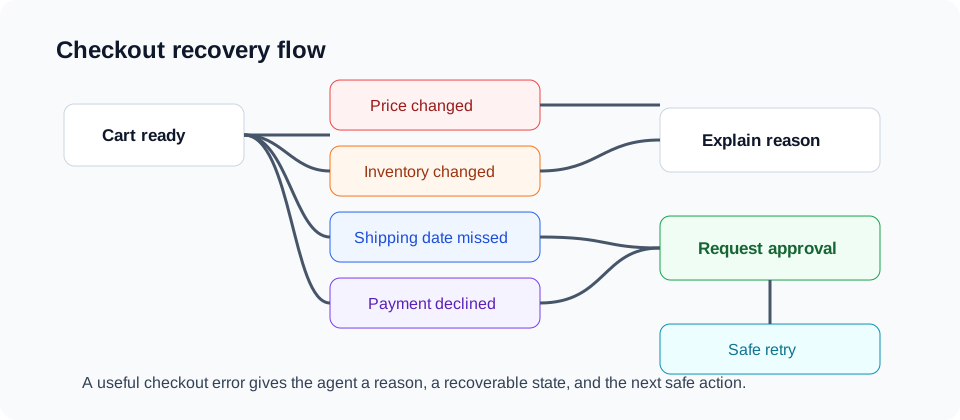
Agentic commerce does not fail only because the model is confused. It fails because commerce systems change under it.
The important failures are ordinary:
| Failure | What the agent needs |
|---|---|
| Item out of stock | Stable reason, alternatives, no payment attempt |
| Variant unavailable | Exact variant that failed |
| Price changed | Old price, new price, threshold exceeded |
| Shipping date changed | New ETA and whether it violates mandate |
| Coupon rejected | Reason and whether checkout can continue |
| Address invalid | Field-level error and accepted formats |
| Payment declined | Retry options without leaking sensitive detail |
| Fraud review | State, next step, and user-visible explanation |
| Session expired | Safe restore or rebuild path |
| Return ineligible | Policy reason before payment |
A shallow checkout integration returns "bad request." A usable one returns enough context for the agent to recover.
For example:
JSON{
"error": {
"code": "shipping_eta_missed",
"message": "The selected shipping method now arrives after the buyer's deadline.",
"constraint": {
"latest_delivery_date": "2026-07-02"
},
"current_option": {
"method": "standard",
"estimated_delivery_date": "2026-07-05"
},
"recoverable": true,
"next_actions": ["select_expedited_shipping", "request_new_approval", "remove_item"]
}
}
That is not fancy. It is the difference between a useful agent and a stalled one.
How should policies become machine-usable?
Policy pages used to be end-of-journey reading material. Agents pull policy into the purchase decision.
A user may ask:
- "Find the cheapest one that I can return after opening."
- "Buy the gift only if it arrives before Friday."
- "Avoid final-sale items."
- "Use my store credit if possible."
- "Do not buy from marketplaces with restocking fees."
The agent now needs policy data before checkout.
Policy pages should be structured like decision tables:
| Policy area | Machine-usable detail |
|---|---|
| Returns | Window, condition, category exceptions, label fee, refund method |
| Exchanges | Eligible categories, price differences, inventory dependency |
| Shipping | Cutoffs, regions, carriers, weekend handling, pickup |
| Warranty | Duration, coverage, exclusions, claim path |
| Subscriptions | Renewal, cancellation, trial conversion, refund rules |
| Marketplace sellers | Who owns fulfillment, returns, support, warranty |
| Promotions | Eligibility, stacking, expiration, product exclusions |
Plain text matters. If a return exception is inside a PDF or image, many agents will miss it. If it is in a table with clear headings, it can be retrieved, cited, and used as a constraint.
Where do protocols fit with browser readiness?
Protocols are useful, but they do not replace a usable browser path.
There will be at least four commerce paths for a while:
| Path | What it is good for | Risk |
|---|---|---|
| Browser agent | Works on today's web | Brittle UI state, bot controls, ambiguous checkout |
| Merchant API | Strong control for known partners | Custom integrations, auth complexity |
| MCP tool | Expose bounded actions to agents | Tool schemas can be vague or overpowered |
| UCP or commerce protocol | Shared commerce objects and payment handlers | Ecosystem adoption and runtime enforcement |
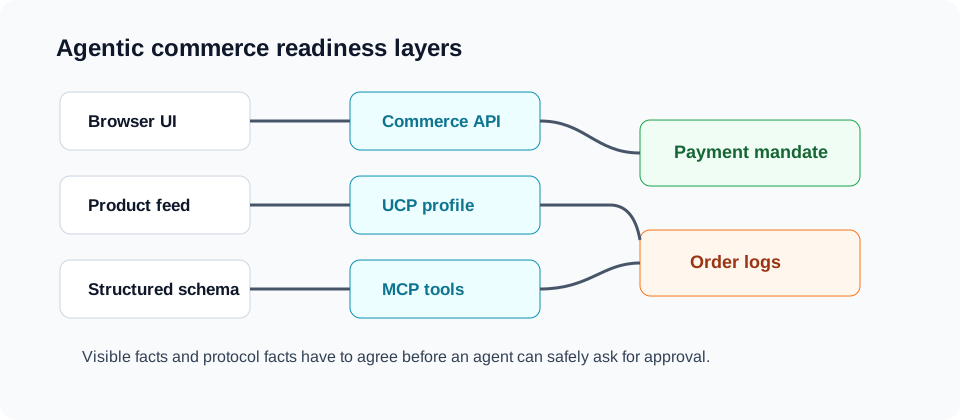
The healthiest architecture is layered:
- Browser UI exposes clear facts and states.
- Product feed and schema match the visible page.
- APIs provide stable commerce actions.
- MCP or UCP exposes agent-specific capabilities.
- Payment mandates bind user approval to specific transaction facts.
- Logs and receipts preserve evidence.
If layer 1 is broken, layer 4 will inherit bad facts. If layer 5 is weak, a beautiful product feed will not save the payment flow.
What should an engineering team audit first?
Start with the user journeys where an agent could help and where mistakes are costly.
Product discovery audit
Pick 20 important products. For each one, compare feed, page, schema, cart, and receipt.
| Question | Pass condition |
|---|---|
| Does the product have a stable ID? | Same ID or mapping across feed, page, cart, order |
| Are variants explicit? | Color, size, region, bundle, plan, material are text fields |
| Does price match across surfaces? | Differences are explained by tax, shipping, discount, or region |
| Is availability visible? | In stock, pickup, preorder, backorder, and region limits are clear |
| Are policies linked? | Return, shipping, warranty, and seller terms are discoverable |
Cart and checkout audit
Run a cart through normal, discount, inventory-change, invalid-address, and failed-payment paths.
| Question | Pass condition |
|---|---|
| Can the agent prove the cart contents? | Line items include product, variant, quantity, total |
| Can the agent prove the approval boundary? | Final payment action is explicit |
| Can the agent recover from failure? | Error includes reason and next action |
| Can the system prevent duplicates? | Idempotency and session state are visible in API path |
| Can support reconstruct the event? | Order logs preserve request, approval, payment, and response |
Policy and support audit
Ask questions a user would delegate:
- "Can I return this after opening?"
- "What happens if it arrives late?"
- "Can I cancel before shipment?"
- "Can I exchange for another size?"
- "Who handles warranty for marketplace sellers?"
If the answer takes a human more than a minute to find, it is not ready for an agent.
What score should a store aim for?
Use a scorecard that reflects the full journey:
| Category | Weight | What to inspect |
|---|---|---|
| Product facts | 20 | Identity, variants, price, availability, compatibility |
| Discovery | 10 | Feed, schema, sitemap, internal search, capability profile |
| Browser usability | 15 | Filters, forms, modals, cart, checkout state |
| Cart and checkout state | 20 | Line items, totals, discounts, status, idempotency |
| Payment and authorization | 15 | Mandate, tokenization, consent proof, expiration |
| Policy and support | 10 | Returns, shipping, warranty, support escalation |
| Logging and evidence | 10 | Request IDs, approval records, receipts, failure reasons |
Below 70, an agent will likely stall or need constant human correction. From 70 to 85, the store can support agent-assisted discovery but should be careful with checkout automation. Above 85, the store is a credible candidate for controlled agentic buying pilots.
FAQ
What is agentic commerce readiness?
Agentic commerce readiness is the ability of a store to support AI-assisted buying without forcing the agent to guess. It covers product identity, variant data, search state, cart state, checkout, payment consent, policy rules, fulfillment, returns, and support evidence.
Does a store need UCP to be agent-ready?
No. UCP can help standardize capabilities, discovery, checkout, and payment handlers, but browser agents and APIs will continue to matter. A store should first make product facts, cart state, checkout errors, and policy data clear. Protocols work better when the underlying commerce state is already reliable.
What is the most dangerous part of agentic commerce?
Payment and checkout are the highest-risk areas because they create financial and legal consequences. The agent should not cross the final payment boundary without a user mandate tied to merchant, items, quantities, total price, shipping, payment method, expiration, and allowed substitutions.
What should ecommerce teams fix first?
Start with product identity, variant consistency, cart line items, final total, shipping promises, return policy, and checkout recovery. These are the parts an agent needs to prove before asking the user for approval.
How should support teams prepare?
Expose order status, cancellation rules, shipment tracking, return eligibility, exchange options, refund timing, and escalation paths in clear text. The agentic journey does not end at payment. Post-purchase support is part of the same delegated workflow.
Conclusion
Agentic commerce will not arrive as one clean protocol switch. It will arrive as messy traffic: AI search, browser agents, wallet integrations, API clients, MCP tools, UCP profiles, payment mandates, and user-directed shopping requests.
The winning stores will not be the ones that add the most acronyms. They will be the ones that make commerce facts explicit.
Product identity should survive the journey. Cart state should be inspectable. Checkout should separate preparation from authorization. Payment should bind to user intent. Policies should be usable before purchase. Support should expose order state after purchase.
That is less glamorous than "AI shopper" demos. It is also the work that makes those demos safe enough to become ordinary.
Sources
- Google Developers Blog: Under the Hood, Universal Commerce Protocol, 2026-06-29.
- Google Developers Blog: A2A, a new era of agent interoperability, 2026-06-29.
- Model Context Protocol tools specification, 2026-06-29.
- Lan et al.: Zero-Trust Runtime Verification for Agentic Payment Protocols, 2026-06-29.
- Debi and Zhu: Whispers of Wealth, Red-Teaming Google's Agent Payments Protocol via Prompt Injection, 2026-06-29.
- Mao et al.: SoK, Security of Autonomous LLM Agents in Agentic Commerce, 2026-06-29.
- Cloudflare Blog: Web Bot Auth, 2026-06-29.
- Princeton, Georgia Tech, IIT Delhi: GEO, Generative Engine Optimization, 2026-06-29.
- CanAgentUse about and contact pages for editorial context.
Share