
The agent protocol soup: what MCP, A2A, UCP ACP etc are really for ?
MCP, A2A, UCP, ACP, and nearby agent protocols are easy to confuse. MCP is access, A2A is delegation, and UCP is commerce meaning.
Share
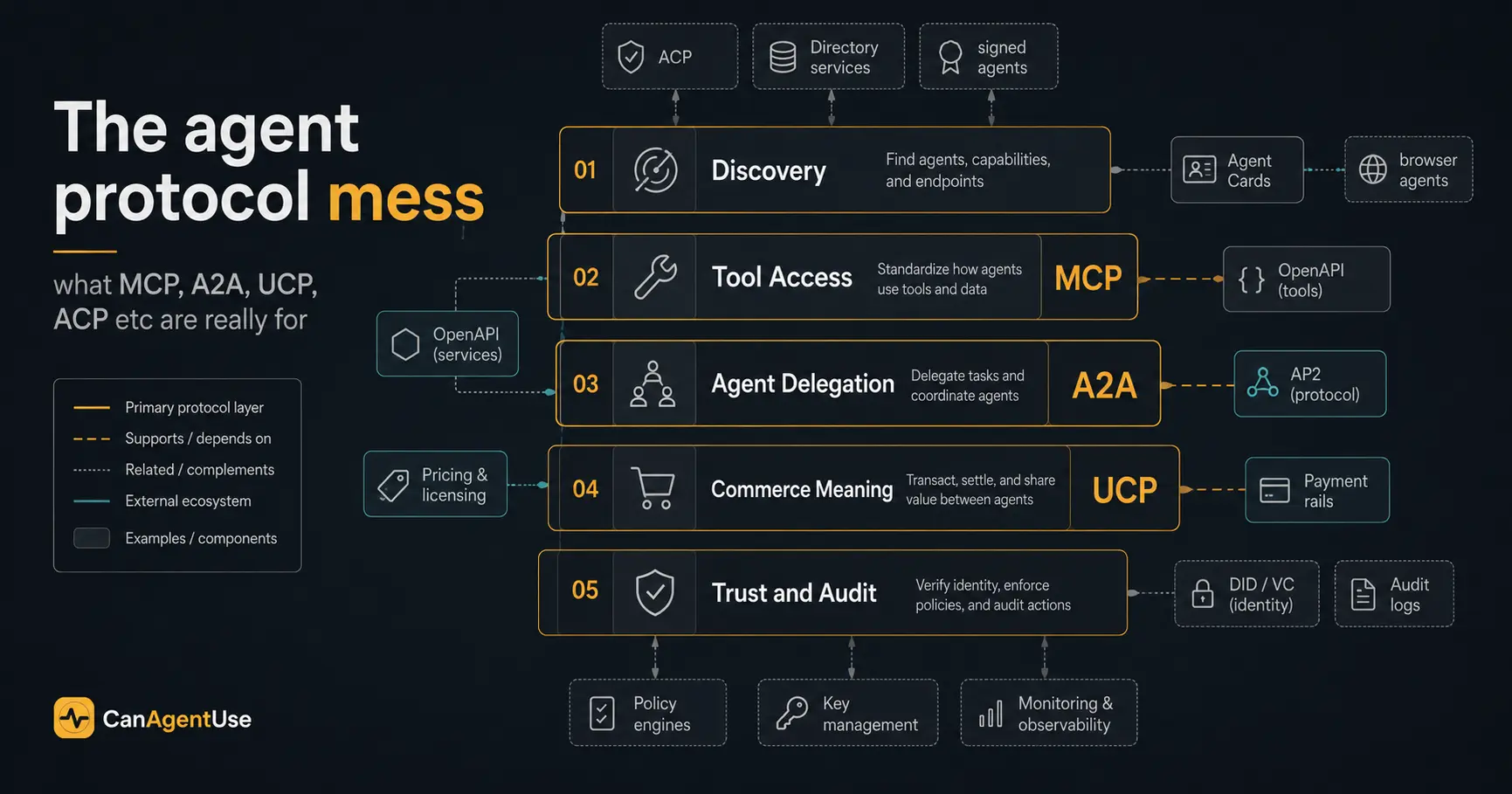
Agent protocols are starting to sound like alphabet soup. MCP. A2A. UCP. ACP. AP2. OpenAPI. Agent Cards. Well-known files. Signed agents. Payment mandates. Browser agents.
The easy reaction is to ask which one wins.
That question is already a little wrong. These protocols are not all trying to be the same thing. Some help agents find capabilities. Some help agents call tools. Some help one agent hand work to another. Some define what a checkout, payment, return, or authorization means once an agent is involved.
MCP, A2A, and UCP get compared because they are all part of the agent conversation. But they live at different layers.
MCP is about access. A2A is about delegation. UCP is about commerce meaning.
That is the whole article in one line. The rest is the part people tend to skip, which is where the mistakes happen.
For implementation context, see our guides to MCP server design, Agent Card discovery, signed agent access, and AI agent protocol adoption.
TL;DR
- MCP gives agents a standard way to use tools, APIs, files, databases, and external systems.
- A2A is for one agent coordinating with, or delegating work to, another agent.
- UCP defines commerce actions such as carts, checkout, payment, orders, returns, and refunds.
- A2A overlaps with MCP when a remote agent looks like a tool. UCP can ride over MCP while adding commerce meaning.
Why the protocol debate gets weird
The protocol debate gets weird because people flatten very different jobs into one vague sentence: "make agents work with other things."
That sentence covers too much. A file search, a database query, a legal task handoff, and a payment authorization are not the same kind of event. They need different levels of structure, trust, and proof.
Here is the cleaner map:
| Layer | Question | Examples |
|---|---|---|
| Discovery | How does an agent find capabilities? | Agent Cards, well-known files, catalogs |
| Tool and context access | How does an agent use external systems? | MCP, OpenAPI, product APIs |
| Agent coordination | How do agents talk or delegate? | A2A |
| Domain meaning | What does a real-world action mean? | UCP for commerce, payment protocols |
| Trust and audit | Who authorized this, and how is it verified? | signed agents, auth scopes, mandates, logs |
This article focuses on MCP, A2A, and UCP because they make the layer problem obvious. MCP gives an agent access to capabilities. A2A is about another agent as an actor. UCP is about commerce actions having the same meaning across merchants, payment providers, platforms, and users.
Protocols are not just there to help the agent know what to do. The outside world also needs to recognize what the agent did.
That second part matters more than people admit.
What is MCP?
MCP is a standard way for AI applications and agents to connect to tools, APIs, files, databases, and external systems. The official Model Context Protocol specification describes a client-server protocol based on JSON-RPC, and the MCP tools documentation explains how servers expose tools that models can invoke.
The useful mental model is simple: MCP lets agents use external capabilities.
Those capabilities can be ordinary but powerful. Query a database. Read files. Search docs. Send an email. Create an issue. Read a calendar. Call a product API. Update a CRM record.
This is why MCP has momentum. Agents need tools, and developers need a consistent way to expose those tools without inventing a custom integration layer every time.
But MCP does not automatically define the business meaning of every action it carries.
Three MCP servers might expose tools called create_checkout, place_order, and submit_basket. The names sound close enough. The behavior might be completely different.
Does the action reserve inventory? Does it charge the user? Does it require final approval? Does it create a legal order? Can the user cancel it? Does it return a signed receipt?
MCP can expose the tool. It does not make every commerce workflow mean the same thing.
What is A2A?
A2A is for agent-to-agent coordination and delegation. The short version is still useful:
MCP is agent to tool. A2A is agent to agent.
Google's A2A launch post frames A2A as an open protocol for agent interoperability that complements MCP. That word matters. A2A is not a subset of MCP. It is a different communication model.
Still, the line is messier in practice.
An MCP server could expose tools like ask_research_agent(task), get_research_status(task_id), and cancel_research_task(task_id). For simple jobs, that may be enough. If the "agent" is basically a remote function with a nice name, MCP can cover a lot of it.
A2A becomes more interesting when the remote thing is not just a capability. It is an actor.
Think about a personal agent asking a travel agent to rebook a trip. Or a support agent coordinating with a vendor's warranty agent. Or a company agent sending a compliance question to a legal agent that has its own rules and private tools.
That remote agent may have identity, policy, memory, task state, authority, and the ability to ask clarifying questions. It may reject the work. It may negotiate scope. It may complete part of the task and hand back a record.
That is not just a function call.
If the remote thing is only a capability, MCP may swallow it. If the remote thing is an actor, A2A has a reason to exist.
What is UCP?
UCP is the odd one out. It is not really a peer of MCP or A2A. It is a commerce-specific meaning layer.
UCP does not mainly ask, "How does the agent call a tool?" It asks, "What does this commerce action mean?"
That is a very different question.
Commerce is not just clicking "buy." It includes product identity, variants, price, tax, shipping, merchant terms, payment authorization, fraud checks, user consent, order state, returns, refunds, disputes, receipts, and support.
That is why UCP-like protocols exist. They try to make commerce actions explicit enough that merchants, payment providers, AI platforms, agents, and users can agree on what happened.
Google's UCP explainer says Universal Commerce Protocol can support multiple transports, including A2A, MCP, and APIs. That is the clue. UCP is not another MCP. UCP defines commerce meaning that can travel over MCP, REST, A2A, or another transport.
MCP can carry a checkout call. UCP tries to define what checkout means.
Where MCP and A2A actually overlap
MCP and A2A overlap when a remote agent can be treated like a tool.
Plenty of tasks are tool-shaped. "Summarize this PDF." "Research this topic." "Extract invoice fields." "Generate itinerary options." The caller sends input, the remote system returns output, and maybe there are status and cancellation calls along the way.
That can fit MCP just fine.
A2A has a stronger case when the remote side has its own task lifecycle. It can ask questions. It can stream progress. It can enforce its own policy. It can use private tools. It can act for another user or company. It can produce a completion record that needs to mean something later.
This is why "A2A is not a subset of MCP" is true, but not enough. The market will not care about tidy protocol boundaries unless the boundary solves a real coordination problem.
If most so-called agents are services with a few callable operations, MCP will absorb many A2A-like cases. A2A survives where independent agents become real actors.
That is the bet underneath the whole thing.
Why UCP is not just commerce tools over MCP
UCP and MCP overlap at a different boundary. MCP can carry the action. UCP defines the meaning of the action.
Imagine every merchant exposes an MCP server with commerce tools. One merchant's checkout creates a temporary session. Another merchant's checkout authorizes payment. A third creates a binding order. A fourth reserves inventory but still sends the buyer to a hosted checkout page.
Same word. Different consequences.
UCP tries to standardize the objects and states around commerce: carts, offers, payment authorization, checkout continuation, orders, returns, refunds, and post-purchase support.
That does not mean UCP must be the only protocol. It means commerce needs a vocabulary stricter than "call the merchant's checkout function."
The important question is not whether an agent can call the function. The important question is whether the merchant, payment provider, AI platform, and user all understand the action the same way.
That is why UCP's durable part is probably the commerce object model, not the exact transport.
If browser agents can shop, why does UCP exist?
A website can be agent-usable without being UCP-compatible. This is where protocol marketing often gets too cute.
A capable browser agent can open a product page, search products, compare prices, add an item to cart, fill checkout forms, ask the user for approval, pay, save a receipt, and track delivery. Browser agents are powerful because they work with the web we already have.
So no, UCP is not required for basic agent commerce.
But browser automation leaves important questions outside the page. The merchant may see a checkout click, but not the full mandate behind it. Was this a user-authorized agent or just another bot? What exactly did the user allow: a maximum price, a delivery deadline, substitutions, address sharing, saved-card use, or warranty add-ons? If something goes wrong, who can prove what the agent was allowed to do and what the merchant actually offered?
That is the gap commerce protocols try to fill.
Browser agents are the compatibility layer. Commerce protocols are the trust layer.
Both can be true. Browser automation proves agents can use commerce. It does not prove commerce systems will prefer that interface at scale. If agentic commerce becomes high volume, high value, or payment sensitive, merchants and platforms will want clearer consent, attribution, audit trails, and order state.
If agents get smarter, do protocols disappear?
No. Some protocols may disappear. The strongest ones will not.
The weak protocols are the ones that exist only because models are clumsy. If a protocol's main job is to force a model through a brittle path because it gets confused, stronger agents will make that less useful.
But intelligence and recognition are different things.
Humans are general intelligence, at least on a good day. We still use invoices, contracts, receipts, boarding passes, prescriptions, tax forms, passports, insurance claims, bank transfer formats, and signatures.
Not because humans cannot understand free-form language. Institutions need structured proof.
General intelligence solves understanding. Protocols solve recognition.
The agent may know what it did. The world still needs proof. Banks, merchants, platforms, companies, regulators, users, and other agents need to agree on who acted, under what authority, with what constraints, and with what result.
As agents become smarter, hand-holding protocols matter less. Protocols for identity, authorization, audit, delegation, payment, liability, and shared business meaning matter more.
The future does not need more rails for weak agents. It needs better proof for powerful ones.
What probably survives
MCP survives strongly, or something close to it does. Agents need tools. Better agents make tool access more useful, not less. MCP solves a real developer problem, and it gives AI systems a common way to reach external capabilities.
The production layer around MCP needs work. Expect stronger auth, better permission boundaries, registries, safer local server behavior, clearer error semantics, and more standard patterns for common tool categories. Low-quality MCP servers and vague tool schemas will not age well.
Browser agents survive too. They are the universal fallback. They work with the existing web, especially the long tail of sites that will never implement every new protocol. Browser automation may not be the preferred path for high-trust, high-volume flows, but it remains the bridge for the messy web.
A2A survives where independent agents become real actors. The pieces that matter are agent identity, capability discovery, task lifecycle, async progress, clarification, cancellation, delegation, completion records, and cross-organization coordination. The weak parts are anything that only wraps a remote function call in extra ceremony.
UCP survives if agentic commerce becomes a real channel. Its strongest pieces are standardized cart objects, offer confirmation, payment authorization, user mandates, order state, returns, refunds, merchant discovery, and audit semantics. Its weaker pieces are exact transport choices and any workflow that duplicates existing commerce APIs without adding trust or agent value.
Weak rails die. Formal proof survives.
What builders should do now
Do not start by asking which acronym to implement. Start with the work agents need to do, how risky it is, and who must trust the result.
If you run a content site, focus on clean pages, crawlable content, structured data, accessible markup, stable URLs, and useful summaries. Agents still need to read the page before they need a special protocol.
If you run a SaaS product, invest in real APIs, OpenAPI, OAuth, audit logs, scoped permissions, and MCP for high-value workflows. MCP is useful when you can expose stable actions with clear inputs, outputs, errors, and permission boundaries.
If you run a marketplace or ecommerce site, make product data, policies, checkout, returns, and support flows machine-readable, machine accessable and browser-agent friendly. Watch UCP-like commerce semantics, especially if AI shopping surfaces, payment providers, or commerce platforms begin pushing adoption.
If you build agents, think hard about identity, task state, delegation, cancellation, clarification, and completion records. That is where A2A-like patterns become more than a dressed-up API call.
Agent readiness is not one protocol. It is whether agents can safely and reliably do useful work with your service.
Conclusion
MCP, A2A, and UCP are easier to understand once you stop forcing them into one category.
MCP lets agents access capabilities. A2A lets agents delegate work. UCP tells commerce systems what agentic transactions mean.
They will overlap. They will compete at the edges. Some parts will get absorbed by APIs, browsers, payment systems, and platform-specific integrations. The useful parts will survive because agents do not act in a vacuum.
Smart agents reduce the need for rigid instructions. They increase the need for formal proof.
Sources
Share