
MCP Server SEO: Make Your API Discoverable to AI Agents
MCP server SEO is technical discovery: OpenAPI, API catalogs, MCP initialize, tools/list, tools/call, OAuth metadata, safe actions, logs, and auth scopes.
Share
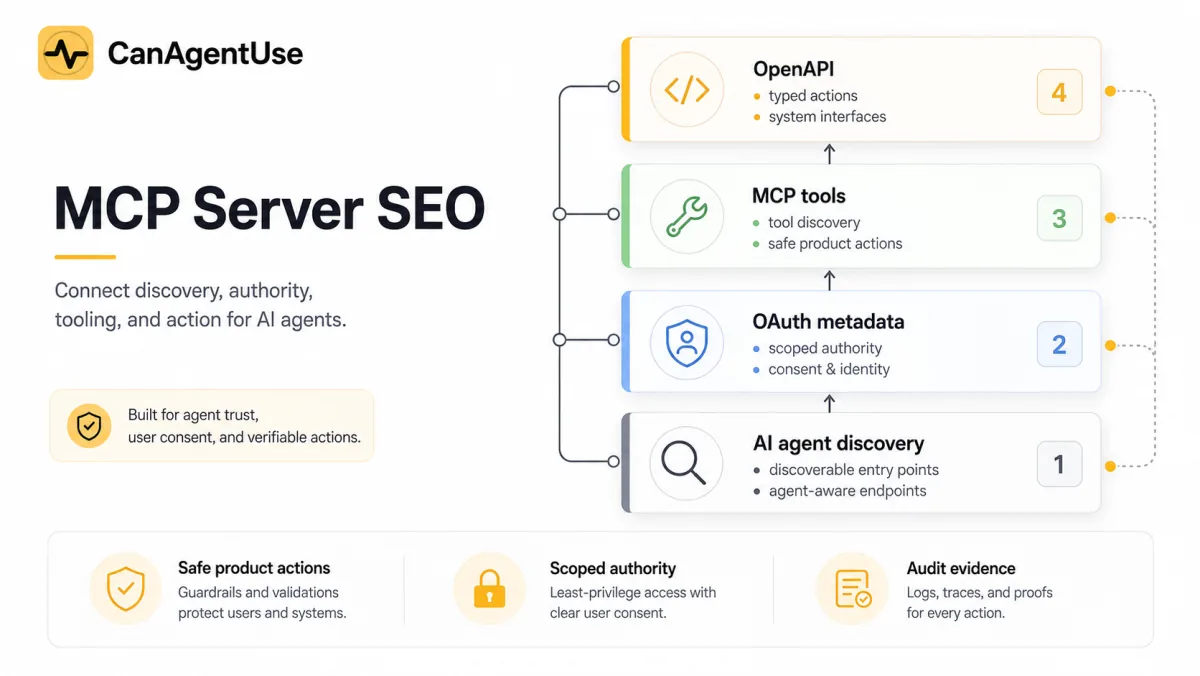
TL;DR: MCP server SEO is not a buying checklist. It is technical discoverability for agent actions. A useful implementation exposes a valid API contract, discoverable MCP metadata, real protocol endpoints, safe tool schemas, OAuth/protected-resource metadata where needed, and logs that prove agents can initialize, list tools, and call safe actions.
The old SEO model asked whether a crawler could discover a page. Agent SEO asks whether an AI client can discover a capability, understand the schema, get the right authority, call the tool, and explain the result. That is a different engineering problem.
This guide builds on the OpenAPI to MCP guide, but it goes deeper into the evidence an MCP-ready API should expose. If your content layer is still blocked, fix the AI crawler audit workflow and the llms.txt vs robots.txt publishing guide before investing in tools.
What is an MCP server?
An MCP server is a program that exposes capabilities to AI applications through Model Context Protocol interfaces. The MCP specification describes server features as prompts, resources, and tools; tools are model-controlled functions that can perform actions or retrieve information (MCP Server Overview, 2026-06-03).
An MCP server gives AI clients structured capabilities instead of forcing them to infer actions from web pages. Tools are the action layer, resources provide context, and prompts guide workflows, each with a different control model.
For a product API, an MCP server might expose search_docs, get_order_status, create_support_ticket, generate_quote, check_inventory, export_report, or schedule_demo. Those are not "SEO pages." They are machine-usable product workflows with names, input schemas, output shapes, and risk boundaries.
This is the action layer of the AI agent readiness playbook. Content can answer the question; MCP can help complete the task.
The SEO angle is discoverability, not ranking. If a user asks an assistant to compare plans, check an order, open a support case, or retrieve a private report, the assistant needs more than a blog post. It needs a trustworthy way to discover and invoke the product action.
Where does OpenAPI fit before MCP?
OpenAPI should be the HTTP source of truth before MCP wraps anything. In practice, teams usually publish it at predictable paths such as /openapi.json, /openapi.yaml, /swagger.json, /api/openapi.json, or /docs/openapi.json, then validate baseline structure and machine-usable details.
| Layer | What it proves | Typical evidence |
|---|---|---|
| OpenAPI | HTTP contract exists | Valid spec, info, paths, operations, responses |
| Machine-usable detail | Agent can call safely | Servers, parameters, request bodies, schemas, security |
| API catalog | Agent can find service docs | /.well-known/api-catalog with service-desc links |
| MCP server card | Agent can find MCP transports | /.well-known/mcp/server-card.json or related path |
| MCP endpoint | Server speaks protocol | initialize, tools/list, tools/call probes |
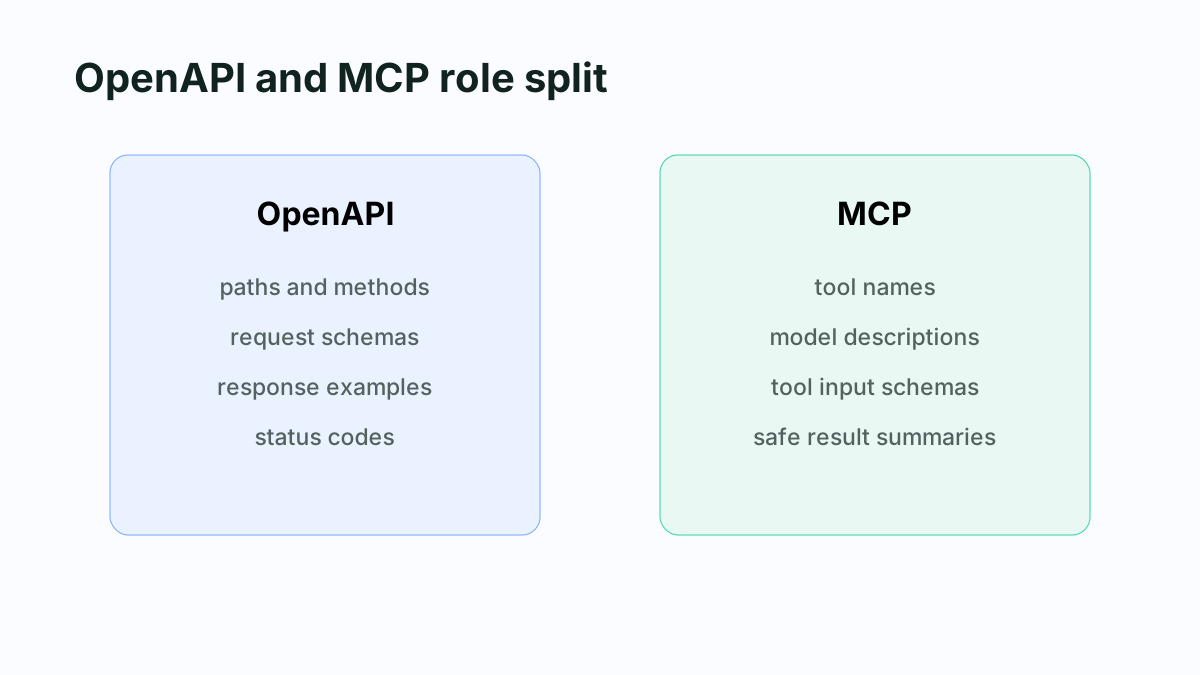
OpenAPI and MCP solve different discovery problems. OpenAPI describes HTTP operations; MCP describes model-facing capabilities. A strong agent API uses OpenAPI as the contract and MCP as the tool interface for selected workflows.
Do not turn every endpoint into a tool. Start from user jobs. If an endpoint does not have clear inputs, safe outputs, or a stable authorization boundary, wrapping it in MCP only makes the problem easier for an AI client to hit.
What should an MCP discovery chain include?
An MCP discovery chain should include public API discovery, protocol discovery, authentication discovery, endpoint verification, and safe invocation testing. The MCP authorization specification also uses OAuth 2.0 Authorization Server Metadata and OAuth Protected Resource Metadata for HTTP-based protected servers (MCP Authorization, 2026-06-03).
| Discovery item | Why it matters | What to test |
|---|---|---|
/.well-known/api-catalog | Finds service descriptions without guessing | Linkset JSON, target status, media types |
/openapi.json | Documents HTTP API operations | Valid OpenAPI, schemas, security, examples |
/.well-known/mcp/server-card.json | Advertises MCP transports and capabilities | Valid card, same-origin transports |
/mcp.json | Provides simple MCP metadata where used | Valid JSON and useful endpoint hints |
| MCP transport endpoint | Proves protocol is real | JSON-RPC initialize response |
tools/list | Proves tools are discoverable | Tool array with names and input schemas |
tools/call | Proves tools are executable | Safe dry-run or read-only invocation |
| OAuth discovery | Shows how clients authenticate | Authorization, token, JWKS, supported flows |
| Protected resource metadata | Ties auth challenge to API resource | RFC 9728 metadata and WWW-Authenticate |
MCP discoverability is a chain, not a file. A server card that points to a normal REST endpoint fails the chain; a real pass requires protocol initialization, capability listing, schema validation, authorization discovery where needed, and safe invocation evidence.
An audit should record each failure separately. "No MCP" is not the same as "server card found but endpoint failed initialize." The first is missing discovery. The second is false advertising.
For search-facing visibility, this evidence complements the GEO vs SEO strategy. GEO earns citations; MCP proves the cited product can be used.
How does the MCP protocol prove the endpoint is real?
The protocol proof starts with JSON-RPC lifecycle and capability negotiation. The MCP base protocol uses JSON-RPC messages, and the server must support lifecycle management before optional features such as tools, resources, and prompts become useful (MCP Base Protocol, 2026-06-03).
A practical audit sequence is:
- Fetch the MCP server card or MCP metadata.
- Extract same-origin transport endpoints.
- Send
initializewith a protocol version and client info. - Validate that the response includes
protocolVersion,serverInfo, andcapabilities. - If
toolsis advertised, calltools/list. - If resources are advertised, call
resources/list. - If prompts are advertised, call
prompts/list. - Run a safe
tools/callprobe only for a low-risk test tool or dry-run.
MCP endpoint verification should not stop at fetching JSON. A real MCP endpoint responds to
initialize, declares capabilities, and returns valid list results for advertised tools, resources, or prompts.
This is where many implementations fail. They publish a JSON file that says "MCP," but the advertised endpoint returns a marketing page, a REST response, a 404, or an SSE stream that does not answer JSON-RPC initialization.
What should a useful MCP tool expose?
A useful MCP tool should expose one stable user task with a clear name, description, input schema, result shape, risk level, and authentication requirement. The MCP tools specification says tools are model-controlled and include metadata describing schema (MCP Tools, 2026-06-03).
| Tool field | Good pattern | Bad pattern |
|---|---|---|
| Name | create_support_ticket | doThing |
| Description | "Create a support ticket for an authenticated customer." | "Runs request." |
| Input schema | Subject, priority, product area, message | Free-form text blob |
| Output | Ticket ID, status, next response window | Unstructured paragraph only |
| Risk | Read-only, dry-run, write, destructive | No classification |
| Auth | Public, user token, admin scope | Hidden session dependency |
| Errors | Field-specific validation errors | Generic "failed" |
Tool quality determines agent usability. The best tools have verb-object names, strict input schemas, structured results, explicit risk, scoped authorization, and predictable errors that help the model recover without guessing.
Good first tools are usually read-only or reversible. Examples include search_docs, get_order_status, list_available_plans, check_inventory, and get_report_status. Riskier tools such as create_support_ticket, generate_quote, or update_subscription need validation, rate limits, idempotency, and user confirmation.
How should MCP authorization work?
Authorization should follow the task. Public tools can be unauthenticated, but private or account-level tools need scoped auth. The MCP authorization spec says protected MCP servers act as OAuth resource servers and use OAuth discovery and protected resource metadata for HTTP-based authorization.
| Action type | Auth posture | Confirmation posture |
|---|---|---|
| Public read | No auth or API key | No confirmation needed |
| User report read | User OAuth scope | User consent required |
| Create support ticket | User token or rate-limited public flow | Confirm subject and submitted content |
| Export private report | User OAuth scope | Confirm recipient and format |
| Billing, deletion, admin | Strong auth and narrow scope | Explicit confirmation every time |
MCP authorization should be least-privilege and per task. HTTP-based protected servers should expose OAuth discovery, protected resource metadata, valid Bearer challenges, and scopes that map to the tools a client is allowed to call.
The MCP tools guidance also emphasizes human oversight for tool invocation. That means your UI or client should show which tool is about to run, what data it will use, and what effect it may have before sensitive operations proceed.
What should an MCP server never do?
An MCP server should never rely on hidden browser state, vague tool descriptions, broad tokens, or unsafe parameter handling. The MCP tools specification warns against putting sensitive values such as passwords, API keys, tokens, or PII into exposed header parameters.
Avoid these patterns:
- Exposing every REST endpoint as a tool.
- Naming tools with vague labels such as
submit,run, orprocess. - Accepting arbitrary natural language instead of typed inputs.
- Returning only prose when a structured result is needed.
- Using one broad token for every tool.
- Hiding cost, side effects, or destructive behavior.
- Depending on implicit session state that the protocol cannot see.
- Publishing a server card before the endpoint actually initializes.
Bad MCP design is usually overexposure. A smaller set of well-described, scoped, testable tools is safer and more useful than a large wrapper around every internal endpoint.
Personal Experience
The most common readiness gap is not lack of ambition. It is lack of boundaries. Teams can list dozens of possible tools, but cannot say which five an agent should safely use on behalf of a first-time user.
How do you audit MCP readiness step by step?
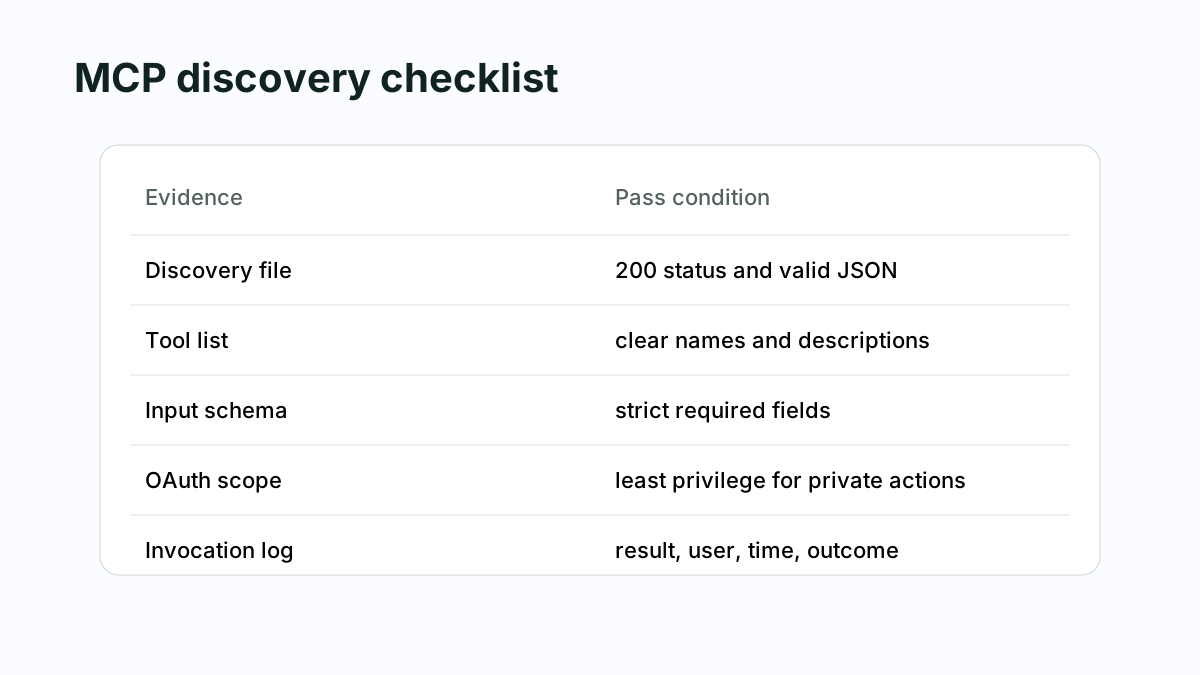
Audit MCP readiness in nine steps. Each step should produce evidence that can be read by engineering, security, product, and SEO without translation.
- Fetch API catalog and OpenAPI candidates.
- Validate OpenAPI structure, schemas, servers, responses, and security.
- Fetch MCP server card or MCP metadata.
- Validate transports and capability declarations.
- Send
initializeto same-origin MCP endpoints. - Probe
tools/list,resources/list, andprompts/listwhen advertised. - Run one safe
tools/calldry-run or read-only invocation. - Validate OAuth/OIDC and protected resource metadata where private tools exist.
- Review logs for tool name, user, scope, input summary, status, and result.
A complete MCP audit moves from discovery to execution. It verifies that metadata exists, endpoints speak MCP, advertised capabilities respond, tools can be safely called, and authorization plus logs support accountability.
What should you expose first?
Expose the lowest-risk tools that help the user complete a clear task. For most SaaS, marketplace, support, analytics, or developer-tool products, the first five tools should map to a small repeatable workflow rather than a giant tool catalog.
| First tool candidate | Why it is useful | Risk notes |
|---|---|---|
search_docs | Answers implementation or product questions | Read-only |
get_account_summary | Gives a user scoped account context | Requires user auth |
create_support_ticket | Starts a common service workflow | Confirm submitted content |
get_order_status | Lets agents answer "where is it?" | Requires ownership check |
generate_quote | Starts a sales workflow with structured inputs | Confirm pricing assumptions |
The first MCP tools should mirror the smallest complete user workflow. For many products, that means search docs, fetch scoped status, create a reversible request, return structured results, and explain next steps without granting broad account power.
This design gives the agent enough to help without handing it account-wide power. Once read and low-risk write paths are stable, add private report export, billing, project, or admin tools behind narrower OAuth scopes and stronger confirmation.
How is MCP different from WebMCP?
MCP is a protocol for servers to expose tools, resources, and prompts. WebMCP is a browser or page-surface pattern that can expose context and actions from interactive elements. They overlap in goal, but they are not the same implementation surface.
WebMCP-style page signals can include navigator.modelContext, data-mcp-tool, tool-name, tool-description, labeled fields, and tool-param-description. Those are useful for in-page action clarity, but they do not replace a real MCP server that answers protocol requests.
WebMCP can make page interactions easier for agents to understand, while MCP server metadata and endpoints make backend tools discoverable and callable. Mature agent readiness can use both surfaces for different jobs.
FAQ
Do I need MCP if I already have OpenAPI?
Not always. OpenAPI may be enough for developer discovery or REST-oriented agents. MCP becomes valuable when AI clients need a tool interface with model-facing names, input schemas, resources, prompts, and standardized invocation.
Should every API endpoint become an MCP tool?
No. Expose only stable user workflows. Internal, destructive, ambiguous, or poorly authorized endpoints should not become tools. Start with read-only or dry-run tools, then add scoped write actions.
What proves an MCP server is real?
A real MCP endpoint should answer initialize, declare capabilities, respond to advertised list methods such as tools/list, and support safe invocation for at least one intended tool if it advertises executable tools.
Does MCP require OAuth?
No. Authorization is optional, but private or account-level tools need scoped authorization. HTTP-based protected MCP servers should follow the MCP authorization guidance around OAuth discovery and protected resource metadata.
Is a server card enough?
No. A server card is discovery metadata. It becomes useful only when the advertised transport endpoints are reachable, speak MCP, and match the capabilities the card declares.
Research sources
- Model Context Protocol, Server overview, 2026-06-03.
- Model Context Protocol, Base protocol overview, 2026-06-03.
- Model Context Protocol, Tools specification, 2026-06-03.
- Model Context Protocol, Authorization specification, 2026-06-03.
- Model Context Protocol, OAuth Client Credentials extension, 2026-06-03.
- RFC 8414, OAuth 2.0 Authorization Server Metadata, 2026-06-03.
- RFC 9728, OAuth 2.0 Protected Resource Metadata, 2026-06-03.
- RFC 9727, API Catalog, 2026-06-03.
Share