
Best AI SEO Tools: 11 Checks Before You Buy
Compare AI SEO tools with 11 checks for crawler access, visibility tracking, schema, llms.txt, OpenAPI, MCP, reporting, remediation, proof, and fixes.
Share
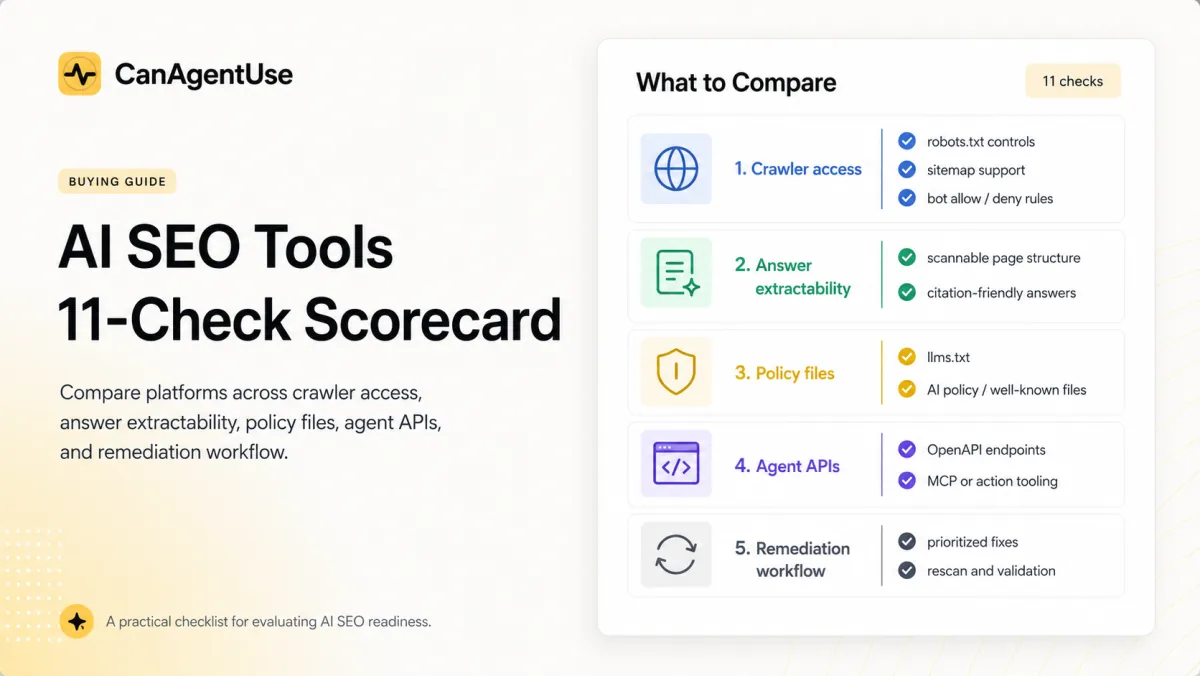
TL;DR: The best AI SEO tools do more than track mentions. A serious stack should measure crawler access, answer extractability, schema,
llms.txt, AI bot policy, OpenAPI, MCP, reports, and remediation workflow. Mention tracking shows whether you appear. Readiness auditing shows whether AI systems can use your site.
AI SEO tools are becoming a noisy category. Some monitor brand mentions in AI answers. Some rewrite content for GEO. Some audit schema and technical SEO. A smaller group checks whether AI crawlers and agents can actually reach and use the site.
This buying guide builds on the GEO vs SEO strategy and the agent-readiness scan. Use it to choose the right tool category before comparing vendors.
What are AI SEO tools?
AI SEO tools help teams improve visibility in AI search, AI Overviews, assistants, and agent workflows. The category includes mention trackers, content optimizers, technical scanners, schema tools, crawler audits, and agent-readiness platforms.
AI SEO tools should be grouped by job, not by buzzword. Mention tracking measures whether a brand appears in AI answers, while technical readiness tools test whether crawlers, schema, content, APIs, and agent contracts support that visibility.
The phrase "AI SEO" often blends GEO, AEO, technical SEO, and agent readiness. That is fine for marketing pages, but risky for buying. A tool that tracks ChatGPT mentions may not detect a blocked OAI-SearchBot. A content tool may not validate OpenAPI or MCP.
What problem are you actually buying for?
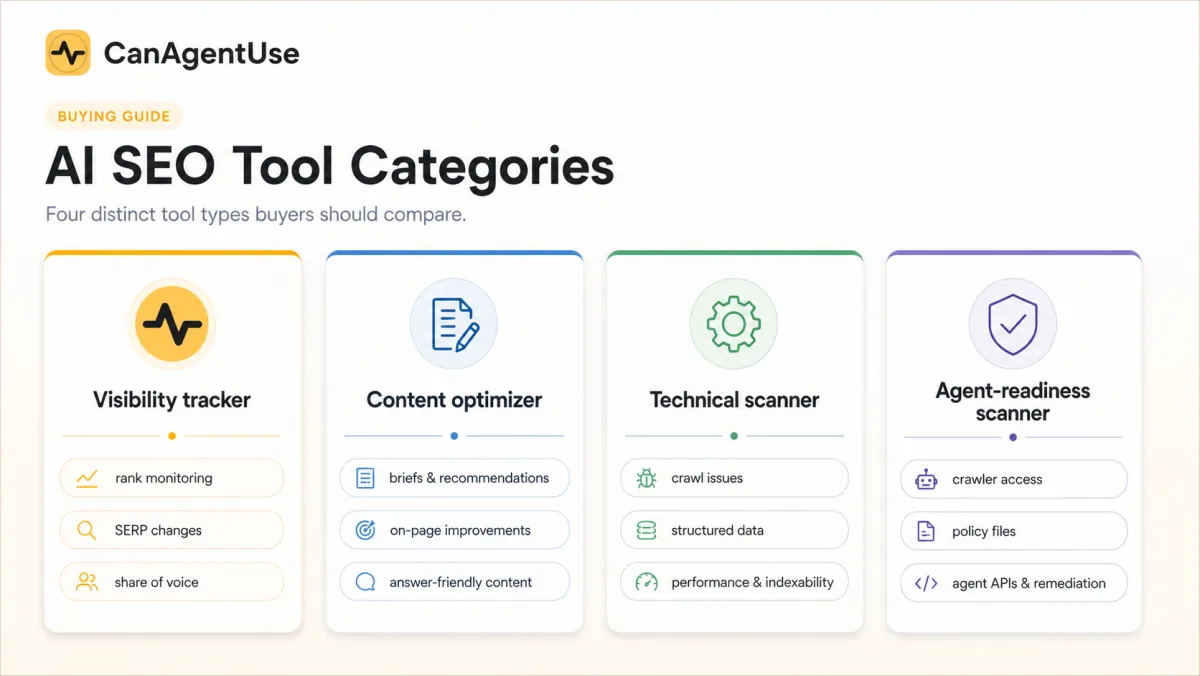
Buy for the bottleneck. If your brand is absent from AI answers, you may need visibility monitoring and better content. If your pages are blocked, you need crawler diagnostics. If agents cannot act, you need API and MCP readiness checks.
| Buying problem | Tool category | What it should prove |
|---|---|---|
| Brand is missing in AI answers | AI visibility tracker | Prompt set, citations, competitors |
| Content is weakly cited | GEO content optimizer | Answer structure and source quality |
| Bots cannot fetch pages | Technical AI scanner | Status codes, robots, WAF logs |
| Agents cannot use product | Agent-readiness scanner | OpenAPI, MCP, OAuth, conversion paths |
Rank tracking is not enough for AI search because AI answers combine retrieval, summarization, citation, and user intent. A useful tool identifies which part of that chain is broken.
Unique Insight
The smartest stack is usually layered. Use Search Console for organic search, an AI visibility tracker for answer presence, and a technical readiness scanner for the things that make AI access and action possible.
Why is rank tracking not enough for AI search?
Rank tracking is not enough because AI search can answer before a user clicks. Pew Research Center found lower click behavior when Google AI summaries appeared, showing that visibility can shift from ranking position to answer inclusion (Pew Research Center, 2026-06-03).
AI SEO measurement should include rankings, citations, answer presence, crawler access, and conversion readiness. A page can rank, be summarized, get no click, and still influence a buyer if the answer cites it clearly.
The AI visibility strategy separates SEO, GEO, AIO, and agent readiness. A buying process should do the same. Otherwise, teams buy a mention tracker and expect it to fix schema, or buy a content tool and expect it to fix WAF rules.
What are the 11 AI SEO tool checks?
The 11-check framework covers the full path from crawl to citation to action. The best tool for you does not need every feature, but your stack should cover all 11 across one or more products.
| Check | Why it matters | Must-have evidence |
|---|---|---|
| AI crawler access | Bots must reach public pages | Status codes and policy |
| Robots policy | Access intent must be explicit | User-agent rules |
llms.txt | AI systems need context | Public file and key links |
| Structured data | Entities need clarity | Valid JSON-LD |
| Semantic HTML | Answers need extraction | Headings, tables, lists |
| AI visibility monitoring | Mentions need tracking | Prompt set and citations |
| Source quality | Claims need trust | Source block and dates |
| OpenAPI | APIs need contracts | Valid spec and examples |
| MCP | Agents need tool actions | Tool list and schemas |
| OAuth metadata | Private actions need scope | Issuer and scopes |
| Remediation workflow | Teams need fixes | Priorities and exports |
A serious AI SEO tool stack should cover crawler access, content extraction, source quality, structured data, AI answer visibility, API discovery, MCP readiness, authentication metadata, and remediation workflow.
For the file layer, use the llms.txt and robots.txt checks. For retrieval proof, use the AI crawler audit workflow. For action readiness, use the MCP server discovery guide.
How does CanAgentUse fit?
CanAgentUse fits as the technical AI readiness scanner, not as a generic all-in-one SEO suite. Its value is testing whether AI systems can crawl, parse, understand, and use the site through public content and machine-readable contracts.
CanAgentUse is strongest where AI SEO becomes operational: crawler access, semantic HTML, schema,
llms.txt, OpenAPI, MCP, OAuth metadata, and conversion readiness. Those checks complement, rather than replace, keyword research and content strategy tools.
Personal Experience
This is the gap many buyers miss. They know whether an assistant mentioned the brand, but not whether the site exposed the evidence and actions that would make the mention repeatable.
Use the CanAgentUse check catalog after you identify your content and visibility needs. It gives engineering, SEO, and product teams a shared list of fixable readiness issues.
What should an evaluation matrix include?
An evaluation matrix should compare tool categories against outcomes, not only features. The buyer should know whether each tool monitors answers, improves content, audits technical access, validates agent APIs, or helps teams fix issues.
| Capability | Visibility tracker | Content optimizer | Technical scanner | Agent-readiness scanner |
|---|---|---|---|---|
| AI answer monitoring | Strong | Sometimes | Rare | Sometimes |
| Content suggestions | Sometimes | Strong | Sometimes | Sometimes |
| Crawler access audit | Rare | Rare | Strong | Strong |
| Schema validation | Sometimes | Sometimes | Strong | Strong |
| OpenAPI and MCP | Rare | Rare | Sometimes | Strong |
| Fix workflow | Varies | Varies | Strong | Strong |
The best AI SEO tool is the one that matches the current bottleneck. A visibility tracker is valuable after pages are reachable and citeable; a readiness scanner is valuable when the technical path is uncertain.
Do a short proof of concept before committing. Pick five URLs, two branded prompts, two non-branded prompts, one API route, and one conversion path. A serious tool should produce evidence you can hand to SEO, engineering, and product without translating every line.
FAQ
What is the difference between AI SEO and GEO tools?
GEO tools usually focus on content that can be cited by generative engines. AI SEO tools can include GEO, AI visibility monitoring, technical crawler access, schema, and agent-readiness checks.
Do AI SEO tools replace Google Search Console?
No. Search Console remains essential for organic search performance, indexing, and query data. AI SEO tools add visibility, extraction, crawler, and agent-readiness views that Search Console does not fully cover.
Should I buy mention tracking or technical scanning first?
Buy the tool that matches your bottleneck. If public pages are blocked or technically weak, scan readiness first. If the site is healthy but absent from AI answers, add visibility tracking and content optimization.
What should a SaaS team audit before optimizing content?
Audit robots.txt, AI crawler access, canonical pages, schema, semantic HTML, llms.txt, OpenAPI, MCP, OAuth metadata, and conversion paths. Content optimization works better when the technical foundation is real.
Research sources
- Pew Research Center, Do people click on links in Google AI summaries?, 2026-06-03.
- OpenAI, Overview of OpenAI Crawlers, 2026-06-03.
- Google Search Central, Robots.txt introduction, 2026-06-03.
- Model Context Protocol, Tools specification, 2026-06-03.
- llmstxt.org, llms.txt proposal, 2026-06-03.
Share