
GEO vs SEO: AI Visibility Strategy Guide
AI summaries changed search behavior: Pew found 8% click rates with summaries vs 15% without. Build SEO, GEO, AIO, and agent readiness as one measurable system.
Share
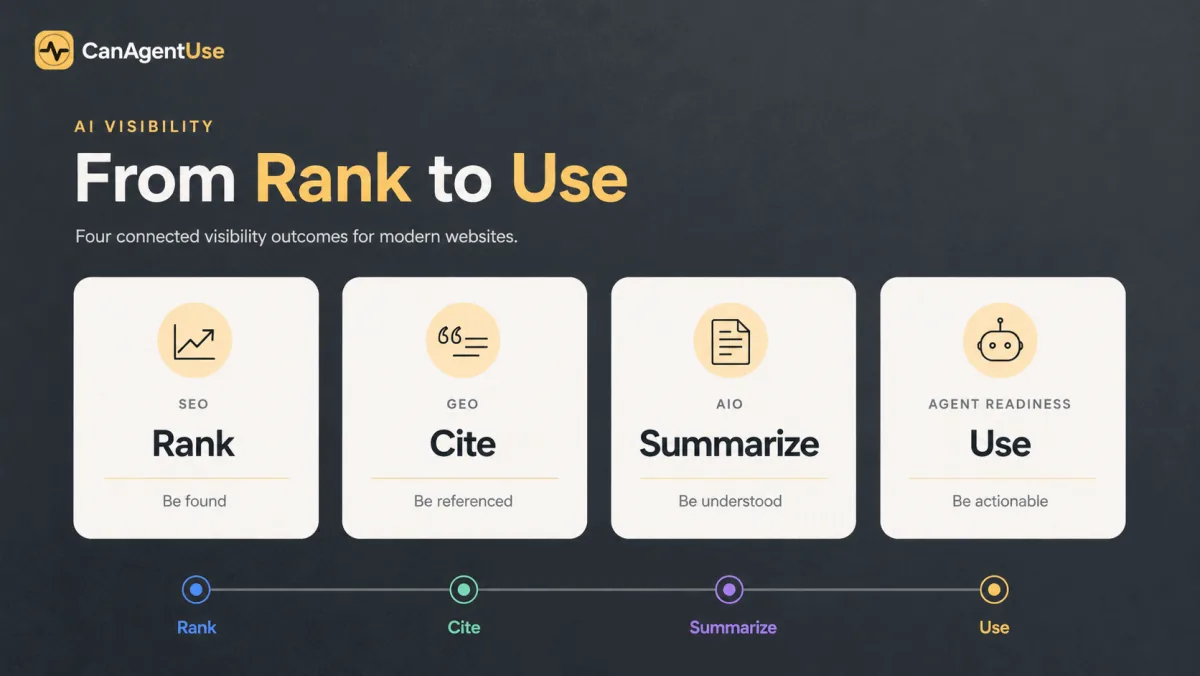
TL;DR: SEO earns rankings. GEO earns citations in generative answers. AIO earns inclusion in AI summaries. Agent readiness lets AI systems use your site. Treat them as connected surfaces with different evidence, not as four names for the same content work.
GEO vs SEO is the wrong fight when it turns into a replacement debate. SEO still matters because organic visibility, technical health, and topical authority feed every other surface. GEO matters because AI answers can cite sources before a user clicks. AIO matters because summaries change the search result itself. Agent readiness matters because the next step after an answer may be an action.
This post is the growth strategy spoke for the AI agent readiness guide. Use it to plan editorial work, then use the crawler access guide and agent API guide to make the strategy technically real.
What is the difference between GEO and SEO?
SEO optimizes pages so search engines can crawl, index, rank, and display them. GEO optimizes content so generative engines can retrieve, understand, and cite it in an answer. In 2025, Pew Research Center found that users clicked traditional results in 8% of visits with AI summaries and 15% without them (Pew Research Center, 2025).
GEO and SEO differ by outcome. SEO seeks ranking and click opportunity. GEO seeks extraction and citation inside AI-generated answers. AI summary behavior makes both necessary because users may see the answer before they decide whether to visit a site.
The practical distinction is structure. SEO cares about crawlability, intent match, authority, internal links, page speed, and helpful content. GEO adds answer-first passages, clear definitions, tables, source-backed claims, entity consistency, and freshness.
That is why a GEO brief should start with the answer format, not only the keyword. Ask what the AI answer should say, which source should support it, which table would make the comparison unambiguous, and which page should receive the next internal link. Keywords still matter, but they are no longer enough to define the work.
How does AIO fit into the strategy?
AIO, or AI Overview optimization, focuses on visibility inside AI summaries on search result pages. It overlaps with GEO because both require extractable answers and trusted sources. It differs because the surface is still a search page, with organic results, source links, and Google-specific ranking systems around it.
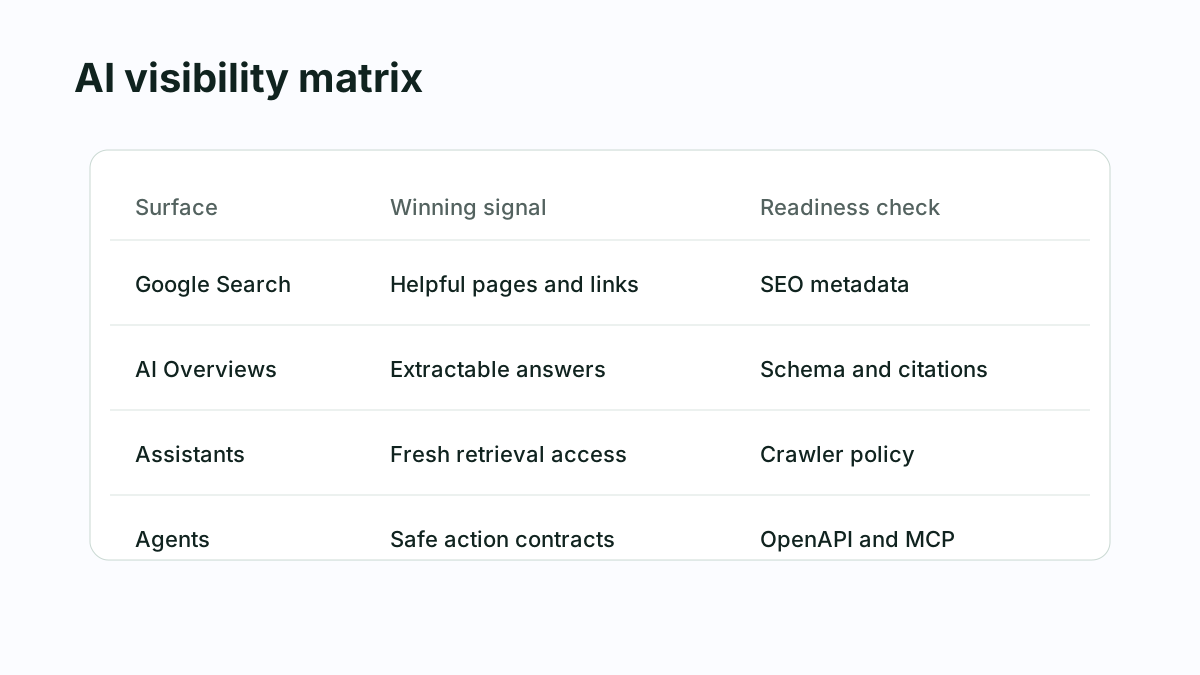
| Surface | Primary outcome | Content requirement | Technical requirement |
|---|---|---|---|
| SEO | Rank and click | Helpful, complete page | Crawl, index, canonical |
| GEO | Citation in AI answer | Self-contained sourced passages | AI crawler access |
| AIO | Inclusion in AI summary | Concise answer plus entity clarity | Schema and page quality |
| Agent readiness | AI-assisted action | Task paths and docs | OpenAPI, MCP, OAuth |
The table is useful because it prevents vague briefs. "Write for AI" is not a brief. "Create a comparison table with sourced evidence for a GEO passage, then expose an API action for agent use" is a brief.
The same matrix can guide reporting. A page may rank well and still be invisible in AI summaries. Another page may be cited by an assistant but fail to convert because the action path is missing. Reporting by surface keeps the team from declaring success too early.
What should a GEO-ready article include?
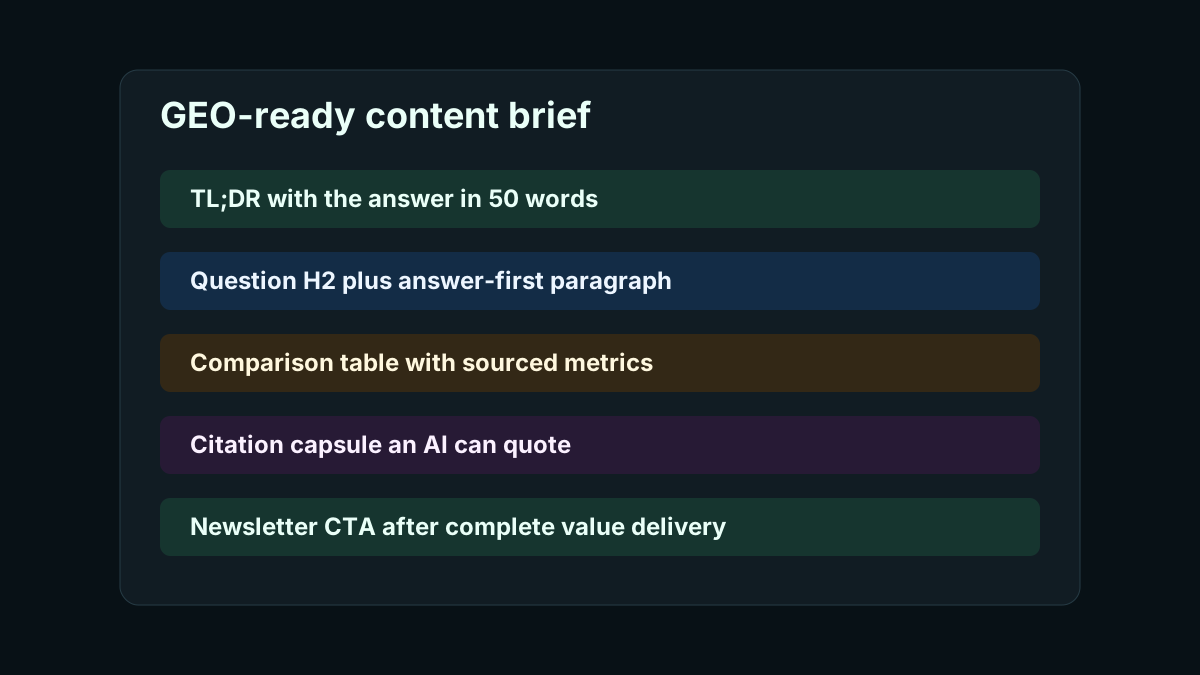
A GEO-ready article should include a direct answer in the introduction, question-led H2s, source-backed claims, comparison tables, short citation capsules, and a source block with retrieval dates. That structure helps readers and gives AI systems stable passages to extract.
A GEO-ready article is not just long-form SEO content. It uses answer-first sections, consistent entity names, cited data, comparison tables, and source blocks so an AI system can extract a complete answer without inventing context.
The article should still be worth reading. Dense content does not mean a wall of facts. It means each section earns its place: a decision, a checklist, a failure mode, a diagram, or a source-backed claim. This is why the launch cluster uses custom SVGs, tables, and implementation checklists instead of generic stock imagery.
Originality is the tie-breaker. If competitors all explain the same acronym, publish the scanner output pattern, the crawler failure taxonomy, or the API checklist that buyers can use in a real meeting. AI systems can summarize generic definitions from many places. They have fewer good sources for operational diagnostics.
Where does agent readiness extend beyond content?
Agent readiness extends beyond content when the user wants a task completed. If a buyer asks an assistant to evaluate a website, compare readiness, or start a scan, content alone cannot finish the workflow. The website needs public action contracts, permissions, and conversion endpoints.
Google's Agent2Agent announcement described a protocol for agents to communicate, securely exchange information, and coordinate across enterprise platforms (Google Developers Blog, 2025). MCP similarly defines tools that models can discover and invoke (Model Context Protocol, 2025). Those protocols point to the same future: visibility and action will converge.
For CanAgentUse, the editorial promise should therefore be practical. Every post should help a reader understand the shift, then give them a way to scan and fix the site. That is why the newsletter and scanner CTAs belong below the content, after the article has delivered real value.
This is also why agent readiness belongs in the content strategy, not only the engineering backlog. A post that promises "AI agents can use your site" must point to the machine-readable contracts that make the claim true. Otherwise the article may win attention but fail the moment a user asks an assistant to act.
How should teams prioritize SEO, GEO, AIO, and agents?
Prioritize by bottleneck. If pages are not crawlable, start with SEO and crawler access. If pages rank but are not cited, improve answer structure and sources. If AI summaries cite competitors, build comparison pages and original data. If agents cannot act, publish OpenAPI, MCP, and auth metadata.
A simple quarterly plan:
- Audit crawler access and robots policy.
- Refresh top commercial pages with answer-first sections.
- Build one pillar cluster around the highest-value category.
- Add source-backed tables and original diagrams.
- Publish or fix OpenAPI and
.well-knowndiscovery files. - Add MCP tools only for stable, safe user workflows.
- Track newsletter signups and scan submissions by source page.
The AI agent readiness guide gives the operating model. The OpenAPI to MCP guide covers the action layer.
When evaluating software to support this work, use the AI SEO tools buying checklist. It separates visibility monitoring, content optimization, technical scanning, and agent-readiness checks so teams buy for the actual bottleneck.
Editorial scorecard
Score each article against four outcomes before publishing. SEO checks whether the page can rank. GEO checks whether a passage can be cited. AIO checks whether the answer can appear in a summary. Agent readiness checks whether the next task can be completed with safe product contracts.
Use a simple red, yellow, green review. Red means the page cannot be crawled, has no sources, or has no clear next action. Yellow means the content is useful but lacks extractable structure or technical proof. Green means the page is crawlable, sourced, internally linked, visually clear, and connected to a measurable product action.
FAQ
Is GEO replacing SEO?
No. GEO extends SEO into AI-generated answer surfaces. Search engines still crawl, index, and rank pages, and those signals can influence whether AI systems trust the content. The better framing is SEO plus GEO plus technical agent readiness.
What is AIO?
AIO usually means optimization for AI Overviews or AI-generated search summaries. It focuses on being included in summary answers on search result pages. AIO overlaps with GEO, but the surface and measurement are search-specific.
Can a small site win GEO visibility?
Yes, when the query is specific and the content is clearer than larger competitors. Small sites can win with first-hand evidence, clean definitions, original diagrams, specific tables, and crawlable pages. They are less likely to win vague head terms without authority.
What should we measure?
Measure crawl access, indexed pages, AI summary appearances, assistant citations, branded AI answers, newsletter submissions, scan starts, and agent-action success. Do not rely on rankings alone. The modern funnel has more surfaces than the search result page.
Research sources
- Pew Research Center, Do people click on links in Google AI summaries?, published July 22, 2025, 2026-05-26.
- OpenAI, Overview of OpenAI Crawlers, 2026-05-26.
- Anthropic Help Center, Does Anthropic crawl data from the web?, updated April 7, 2026, 2026-05-26.
- Perplexity, Perplexity Crawlers, 2026-05-26.
- Model Context Protocol, Tools specification, 2026-05-26.
- Google Developers Blog, Announcing the Agent2Agent Protocol, published April 9, 2025, 2026-05-26.
Share