
OpenAPI to MCP: Complete Agent API Guide
Agents need more than crawlable pages. Build an action layer with OpenAPI, OAuth, MCP tools, safe confirmation, measurable workflows, and audit logs now.
Share
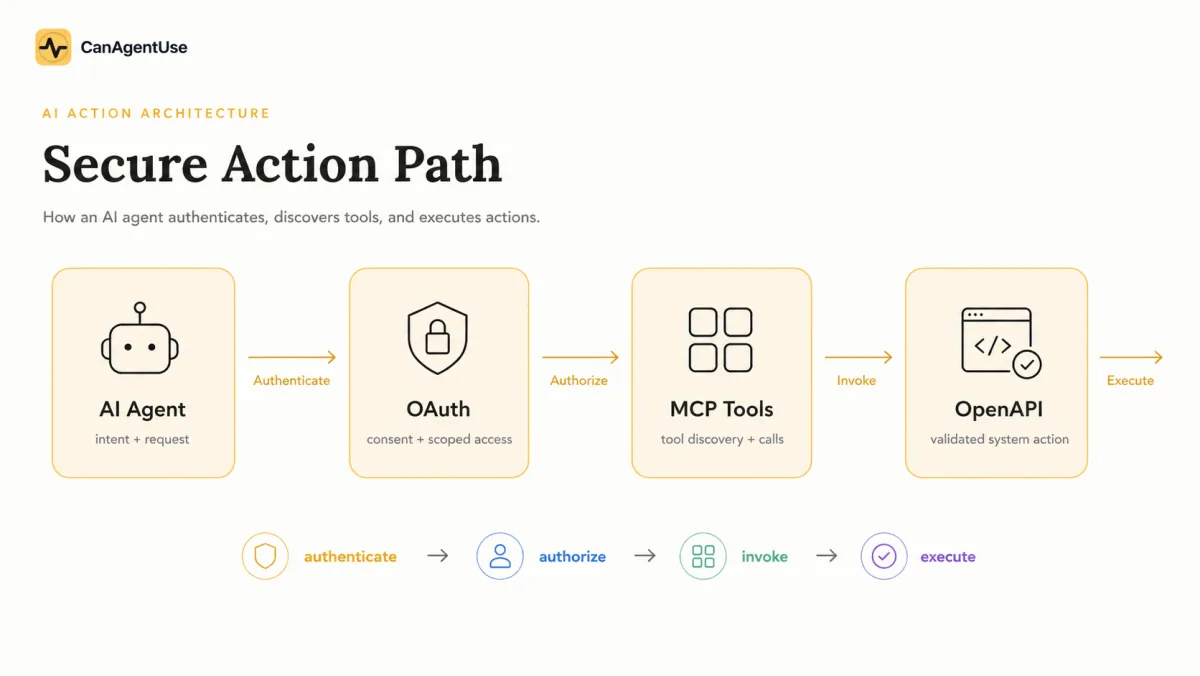
TL;DR: Agent-ready APIs need discoverable contracts, scoped authentication, safe actions, and tool metadata. OpenAPI describes HTTP capability. MCP exposes tools a model can discover and invoke. A strong agent-readiness plan uses both, with user confirmation for sensitive actions.
Crawlable content helps an AI system answer. Agent-ready APIs help it act. The difference is important. A user can ask an assistant, "Scan my site and send me the report." That task needs a public action contract, authentication rules, a consent model, and a response format the agent can understand.
This guide is the technical action spoke in the AI agent readiness cluster. Read it after the AI crawler access guide if your pages are not reliably reachable yet.
What makes an API agent-ready?
An API is agent-ready when an AI system can discover what the API does, understand input and output schemas, authenticate safely, invoke approved actions, and explain the result to the user. OpenAPI handles much of the HTTP contract. MCP adds a model-facing tool layer for systems that support it.
An agent-ready API combines discovery, schema, authentication, confirmation, and auditability. OpenAPI describes endpoints and data shapes, while MCP can expose model-controlled tools that let AI systems discover and invoke approved product actions.
The Model Context Protocol tools specification says MCP servers can expose tools that models can invoke, and that tools include metadata describing schema (Model Context Protocol, Tools, 2025). The same page also emphasizes human-in-the-loop controls for trust and safety.
The easiest way to find gaps is to write the agent task in plain English, then trace every required contract. "Scan this domain and email me the report" needs URL validation, scan creation, progress polling, report export, email capture, and consent. If one of those steps exists only in a React component with no documented API, an external agent cannot depend on it.
Where does OpenAPI fit?
OpenAPI is the foundation for HTTP API discovery. It tells agents and developers what endpoints exist, which methods they accept, what parameters are required, and what responses look like. Without it, an agent has to infer action contracts from prose, which is fragile and risky.
For a product like CanAgentUse, OpenAPI should cover actions such as creating a scan, checking scan status, exporting a report, and submitting a lead. Each operation needs clear summaries, schemas, status codes, and examples. The agent should not guess what a "website" string means or whether a scan is synchronous.
Good OpenAPI descriptions also reduce support load. They tell a model which endpoint starts work, which endpoint polls work, which error means rate limited, and which fields are safe to show to a user. Treat examples as product copy for agents: short, literal, and aligned with the UI.
When should you add MCP?
Add MCP when an AI client needs a tool interface, not only a REST contract. MCP is useful when tools need model-facing names, descriptions, input schemas, resources, prompts, or a standardized tool-list operation. The MCP tools spec defines tools/list for discovery and tool metadata (Model Context Protocol, 2025).
OpenAPI and MCP should not compete. OpenAPI is still the system of record for your HTTP surface. MCP can wrap stable actions with model-friendly affordances. If an endpoint is unsafe, ambiguous, or missing authorization, wrapping it in MCP makes the risk more visible, not less real.
For the discoverability layer after a first implementation, use the MCP server SEO guide. It covers server metadata, OAuth boundaries, tool descriptions, and audit evidence for agent-facing actions.
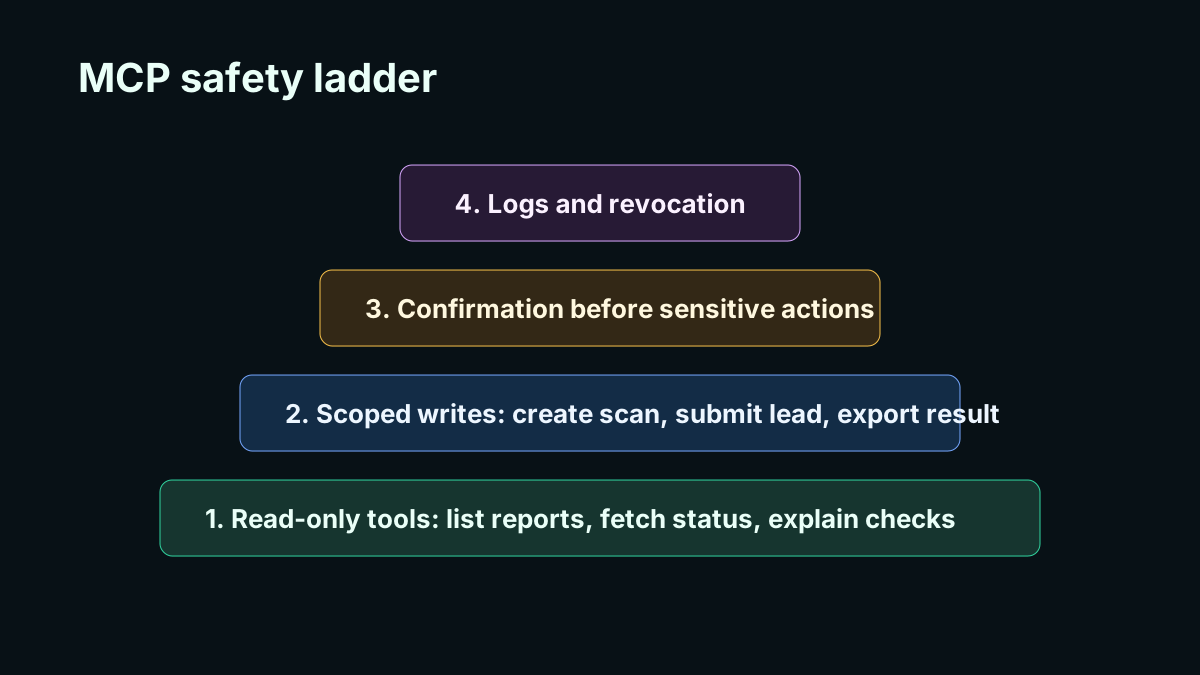
Start with read tools. A list_checks tool, get_report_status tool, or explain_failed_check tool is easier to reason about than a tool that mutates account state. Once read paths are stable, add narrow write tools such as create_scan or submit_newsletter_signup. Reserve account changes, billing changes, and destructive actions for flows with explicit confirmation and stronger user identity.
| Capability | OpenAPI role | MCP role | Readiness check |
|---|---|---|---|
| Discover actions | Endpoint catalog | Tool list | Public route responds |
| Validate input | JSON schema | Tool input schema | Required fields clear |
| Control access | OAuth scopes | Client approval flow | Sensitive actions gated |
| Explain output | Response schema | Tool result content | Results are parseable |
How should authentication work?
Authentication should be scoped to the user's intent. A scan creation tool might need permission to submit a URL. A report export tool might need account access. A billing or deletion tool should require stronger confirmation. The agent should never receive broad credentials when a narrow token or session-bound action will do.
Google announced Agent2Agent with a focus on secure communication and coordination across enterprise systems (Google Developers Blog, 2025). That direction reinforces a basic rule: agent actions need explicit authority boundaries.
For public websites, the minimum authority boundary is source-path tracking. If a user came from a blog post, the lead, scan, or newsletter submission should preserve that source. It helps analytics, but it also helps support teams understand which educational promise led to the action.
Agent authentication should be narrow and task-specific. Use OAuth scopes, short-lived tokens, and user confirmation for sensitive operations so an agent can complete the requested action without receiving broader account authority than the task requires.
What safety controls should every tool have?
Every tool should be classified by risk. Read-only tools can be broadly available. Write tools need validation, idempotency where possible, and user-visible confirmation. Destructive or financial tools need stronger verification, logging, and revocation. The MCP specification notes that applications should keep humans able to deny tool invocations for safety (Model Context Protocol, 2025).
Use this minimum tool checklist:
- Name the tool with a verb and object, such as
create_scan. - Keep the description specific enough for a model to choose correctly.
- Validate every input with a strict schema.
- Return structured results and human-readable summaries.
- Require confirmation for cost, identity, deletion, or external submission.
- Log the user, tool, input summary, result, and timestamp.
- Provide revocation for credentials and sessions.
Do not hide failure states. Agents need crisp errors just as much as happy paths. A rate-limit response should say when to retry. A validation error should name the bad field. An authorization error should distinguish signed-out, missing scope, and expired session states. Those details prevent the model from inventing the next step.
GEO connection
GEO gets the agent to the answer. API readiness gets the agent to the outcome. A buyer may ask, "Which scanner checks whether AI agents can use my website?" A GEO-ready post can earn the citation. An agent-ready API can let the assistant start a scan after the user consents.
That means API pages should link back to educational content and vice versa. The GEO vs SEO guide explains how citation surfaces differ. The pillar guide shows how API discovery fits the full website readiness model.
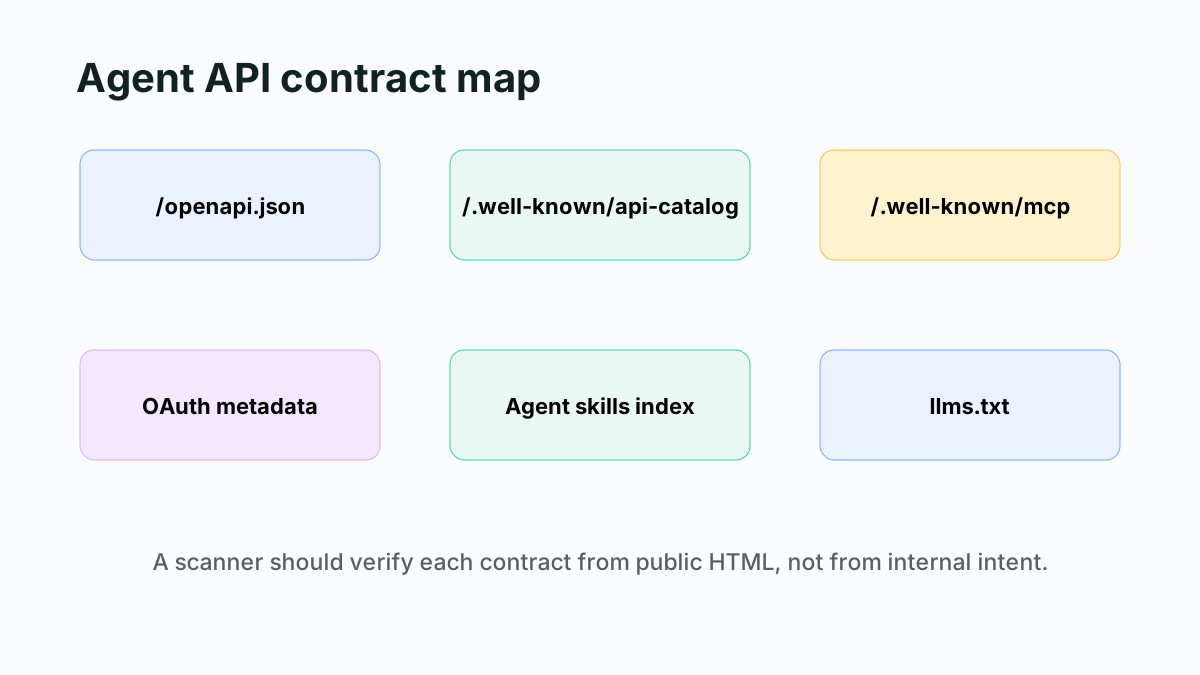
The content and API teams should share a release checklist. When a new public action ships, update the docs page, OpenAPI schema, API catalog, MCP tool description, and any educational article that promises the workflow. That keeps AI-visible claims aligned with the product reality.
For measurement, track the full path: page citation, tool discovery, tool invocation, successful result, and follow-up conversion. That is the difference between being mentioned by an AI system and being usable by one.
FAQ
Is OpenAPI enough for agent readiness?
OpenAPI is necessary for many API-first products, but it is not always sufficient. Agents also need crawlable documentation, authentication rules, safe action design, structured outputs, and sometimes MCP tools that describe actions in a model-friendly way.
Should every API endpoint become an MCP tool?
No. Expose only actions that make sense in a user-directed agent workflow. Internal, destructive, ambiguous, or low-value endpoints should stay out of the tool layer. A smaller set of well-designed tools beats a large unsafe wrapper.
Do agent tools need human confirmation?
Sensitive tools should. The MCP tools specification explicitly recommends a human in the loop with the ability to deny tool invocations. That is especially important for payment, deletion, identity, messaging, and any action that affects another system.
How can we test an agent-ready API?
Test discovery files, schema validity, auth scopes, example requests, error states, and live tool invocation. Then run an end-to-end task: ask an agent to discover the capability, request consent, perform the action, and explain the result.
Research sources
- Model Context Protocol, Tools specification, published June 18, 2025, 2026-05-26.
- Google Developers Blog, Announcing the Agent2Agent Protocol, published April 9, 2025, 2026-05-26.
- OpenAI, Overview of OpenAI Crawlers, 2026-05-26.
- Perplexity, Perplexity Crawlers, 2026-05-26.
Share